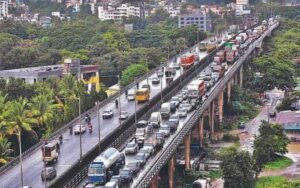
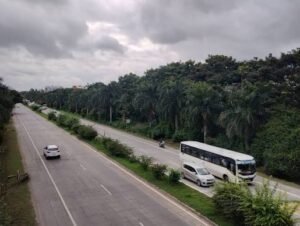
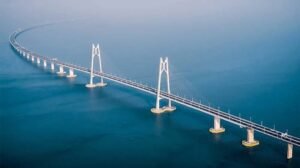
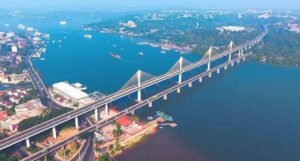
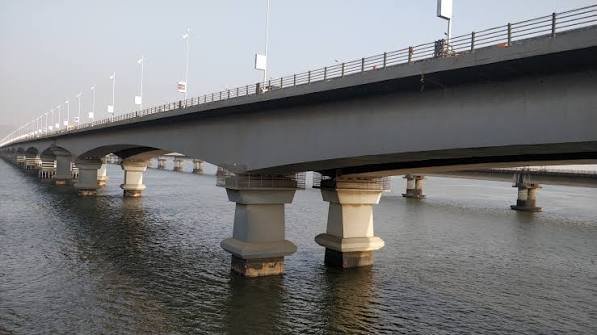
Thane Creek Bridge is one of the most important road connections between Mumbai and Navi Mumbai. Commonly called Vashi Bridge, the crossing carries the Sion-Panvel Highway over Thane Creek between Mankhurd on the Mumbai side and Vashi on the Navi Mumbai side. It is a major gateway for motorists travelling towards Navi Mumbai, Panvel, Pune, Goa and the Jawaharlal Nehru Port region.
The name “Thane Creek Bridge” actually represents several generations of bridges built at approximately the same location. The original Thane Creek Bridge-1 (TCB-1) opened in 1973. It was followed by the much larger Thane Creek Bridge-2 (TCB-2) in 1997. Growing traffic eventually required another major expansion, leading to Thane Creek Bridge-3 (TCB-3), comprising two additional three-lane bridges alongside the existing crossing.
The first three-lane arm of TCB-3 opened on 14 October 2024, while the second, Mumbai-bound arm was commissioned on 5 June 2025. With both sections operational, the corridor has considerably more road capacity than before and is better equipped to handle traffic between Mumbai and Navi Mumbai.
Quick Overview of Thane Creek Bridge
| Particular | Details |
| Name | Thane Creek Bridge |
| Popular Name | Vashi Bridge |
| Location | Mumbai-Navi Mumbai, Maharashtra |
| Crosses | Thane Creek |
| Connects | Mankhurd, Mumbai with Vashi, Navi Mumbai |
| Major Road | Sion-Panvel Highway |
| TCB-1 Opened | 1973 |
| TCB-2 Opened | 1997 |
| TCB-2 Length | About 1.84 km |
| TCB-3 Configuration | Two separate three-lane bridges |
| TCB-3 Main Creek Crossing | About 1.8 km each |
| TCB-3 First Arm Opened | 14 October 2024 |
| TCB-3 Second Arm Opened | 5 June 2025 |
| TCB-3 Developer | Maharashtra State Road Development Corporation |
| TCB-3 Contractor | Larsen & Toubro |
| Combined Road Capacity | Up to six lanes in each direction across TCB-2 and TCB-3 |
| Nearby Areas | Mankhurd, Vashi, Sanpada, Turbhe and Chembur |
| Known For | Major Mumbai-Navi Mumbai road gateway |
UP State Bridge Corporation records the second Thane Creek Bridge at approximately 1,837 metres, while project documents for TCB-3 describe two new three-lane bridges of roughly 1.8 km each.
Where is Thane Creek Bridge Located?
Thane Creek Bridge crosses Thane Creek between Mankhurd in eastern Mumbai and Vashi in Navi Mumbai.
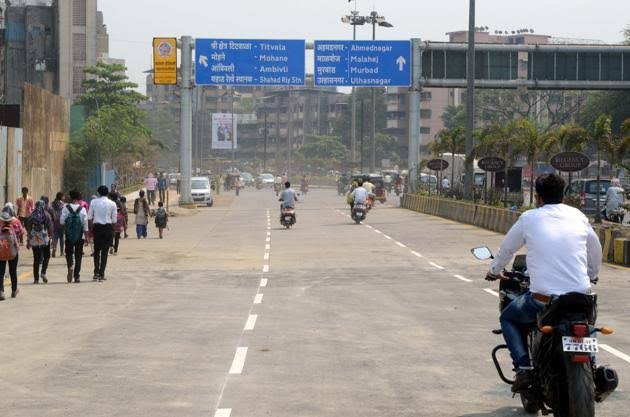
The Mumbai approach is connected with the Mankhurd-Chembur side of the Sion-Panvel Highway. After crossing the creek, vehicles enter Vashi and can continue through Navi Mumbai towards Sanpada, Nerul, CBD Belapur, Kharghar and Panvel.
Its location makes the bridge one of Mumbai’s important eastern entry and exit points. It is particularly useful for motorists from central and eastern Mumbai who need to reach Navi Mumbai without travelling north towards the Airoli crossing.
The bridge also supports traffic travelling much farther than Vashi. The Sion-Panvel corridor is a major route towards the Mumbai-Pune Expressway and other highways leading towards Pune and southern Maharashtra.
Thane Creek Bridge Route and Road Connectivity
The most common route through Thane Creek Bridge follows the Sion-Panvel Highway.
A typical Mumbai-to-Navi Mumbai movement is:
Sion/Chembur → Mankhurd → Thane Creek Bridge → Vashi → Sanpada → Nerul/CBD Belapur → Kharghar → Panvel
Important connections include:
- Mankhurd: Immediate Mumbai-side approach to the bridge.
- Chembur: Major eastern Mumbai locality connected through the Sion-Panvel corridor.
- Vashi: First major Navi Mumbai node after crossing the creek.
- Sanpada: Located immediately beyond Vashi towards central Navi Mumbai.
- Turbhe: Important commercial and industrial area accessible from Vashi.
- Nerul: Major residential and institutional node farther south.
- CBD Belapur: Administrative and commercial centre of Navi Mumbai.
- Kharghar: Large residential and institutional area along the Panvel corridor.
- Panvel: Important road and railway gateway for onward travel.
- Pune: Reached through Panvel and the Mumbai-Pune Expressway.
- JNPA/JNPT region: Commercial traffic can continue towards the port and Uran road network.
The crossing is especially important for commercial traffic associated with Jawaharlal Nehru Port. MSRDC planning for TCB-3 specifically considered the growing volume of commercial vehicles travelling through the Mumbai-Navi Mumbai corridor.
Why is Thane Creek Bridge Important?
Thane Creek Bridge helped make the large-scale development of Navi Mumbai practical.
The first permanent road bridge across this part of Thane Creek opened in 1973, during the early period of Navi Mumbai’s development as a planned counter-magnet to Mumbai. The direct road connection significantly improved accessibility between the old city and the emerging township.
Today, the corridor serves several different types of traffic:
- Daily Mumbai-Navi Mumbai commuters
- Commercial vehicles and freight traffic
- Vehicles travelling towards JNPA
- Airport-related traffic serving Navi Mumbai
- Motorists travelling towards Panvel and Pune
- Intercity traffic heading towards Goa and southern Maharashtra
Urbanisation in Navi Mumbai substantially increased traffic after 2010. Roads approaching the creek had much greater capacity than the bridge itself, creating a bottleneck where vehicles converged onto the older six-lane crossing. This capacity mismatch became the main reason for constructing TCB-3.
Traffic Conditions at Thane Creek Bridge
Traffic conditions at Thane Creek Bridge have improved considerably following the opening of both arms of TCB-3.
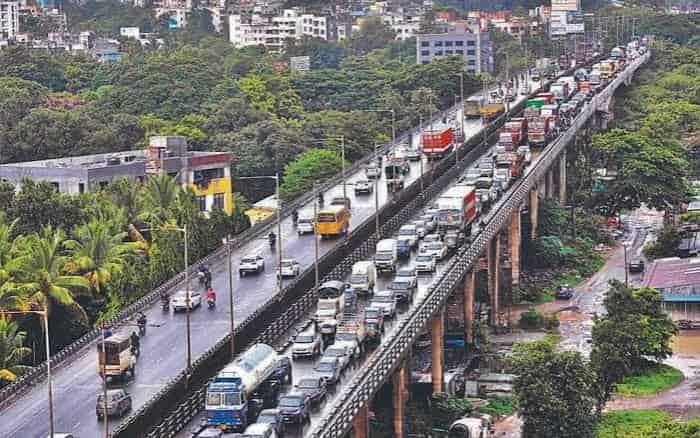
Before the expansion, vehicles approaching from road corridors effectively totalling around ten lanes had to converge onto the six-lane TCB-2. This frequently produced queues at the Vashi and Mankhurd approaches, particularly during peak periods and weekend travel.
The first TCB-3 carriageway opened in October 2024 and provided immediate additional capacity for traffic leaving Mumbai towards Navi Mumbai and destinations beyond.
The second three-lane arm opened on 5 June 2025. Its commissioning increased Mumbai-bound capacity across the creek from three lanes to six lanes when the new and existing carriageways are considered together.
Traffic may still slow around:
- Mankhurd approaches
- Maharashtra Nagar junction
- Vashi entry and exit points
- Sion-Panvel Highway during office peaks
- Holiday and weekend travel periods
- Accidents or vehicle breakdowns
- Heavy monsoon rain
The physical creek crossing is therefore less of a bottleneck than it was before TCB-3, although traffic on the connecting highway can still affect overall journey time.
Three Generations of Thane Creek Bridge
One of the most interesting features of this crossing is that its history can be seen through three generations of road infrastructure standing close together.
Thane Creek Bridge-1
The first road bridge opened in 1973. It was a two-lane structure built to create a direct connection between Mumbai and the emerging Navi Mumbai area.
Structural deterioration subsequently affected the bridge, and it was eventually replaced as the main crossing by TCB-2. The old structure has not served as the primary regular traffic bridge for many years, although it has been used selectively during traffic-management and repair arrangements.
Thane Creek Bridge-2
The second bridge became the main road crossing in 1997.
UP State Bridge Corporation, which constructed it, records a length of approximately 1,837 metres. The structure provided significantly greater capacity and became the principal Vashi road connection for Mumbai-Navi Mumbai traffic.
Continued urban growth eventually pushed TCB-2 close to saturation, leading to plans for another expansion.
Thane Creek Bridge-3
TCB-3 added two separate three-lane bridges, one on either side of the existing TCB-2 arrangement. Each principal creek crossing is approximately 1.8 km long.
The project was developed by MSRDC, with Larsen & Toubro as contractor. Contemporary project reporting put the overall project cost at around ₹775 crore.
Together, TCB-2 and TCB-3 provide 12 lanes across the corridor—six in each direction—substantially increasing the capacity of this important Mumbai gateway.
Engineering Challenges of Thane Creek Bridge-3
Building TCB-3 was more complicated than simply constructing another bridge beside an existing road.
One of the new three-lane structures had to be constructed in a gap of only around 22 metres between existing bridges. Engineers also had to work in shallow tidal water without disturbing the foundations of the older structures.
Other challenges included:
- Soft and marshy creek conditions
- Tidal movement
- Limited space for heavy construction machinery
- Continuous traffic on adjoining bridges
- Mangrove protection requirements
- Environmental approvals
- Work around existing utilities and bridge foundations
Construction was also delayed by environmental clearances and the COVID-19 period. The project affected mangrove areas, requiring compensatory measures and financial contributions towards mangrove and flamingo-habitat conservation.
The completed TCB-3 structures are designed for a 100-year service life and for heavy vehicular loads.
Thane Creek and Its Environmental Importance
Thane Creek is not merely a transport corridor. It is also one of the Mumbai region’s most important coastal wetland environments.
The Maharashtra government issued a notification in August 2015 for the creation of the Thane Creek Flamingo Sanctuary. The creek’s mudflats, mangroves and shallow waters provide feeding and resting habitat for flamingos and numerous other waterbird species.
This environmental sensitivity affected the planning and construction of TCB-3. Mangrove clearance required approvals and compensatory plantation measures, while money was allocated towards conservation of the creek and flamingo habitat.
The result is an unusual urban setting where major road, railway and port-related infrastructure runs beside an ecologically significant tidal creek.
Public Transport Near Thane Creek Bridge
Thane Creek Bridge is used by road-based public transport operating between Mumbai and Navi Mumbai.
BEST, Navi Mumbai bus services, taxis, app-based cabs and other vehicles use the wider Sion-Panvel corridor.
For suburban railway passengers, Mankhurd and Vashi railway stations provide convenient rail access on opposite sides of the creek.
Importantly, Harbour Line trains do not use the road bridge. A separate railway bridge crosses Thane Creek close to the road structures, allowing suburban trains to travel between Mankhurd and Vashi independently of road traffic. The rail crossing became part of the Harbour Line expansion towards Vashi in the early 1990s.
Major Landmarks and Facilities Near Thane Creek Bridge
Important places around the bridge corridor include:
- Vashi: Major commercial, residential and transport node in Navi Mumbai.
- Vashi Railway Station: Important Harbour Line railway station.
- Mankhurd Railway Station: Major suburban station on the Mumbai side.
- Vashi Toll Plaza: Located on the Navi Mumbai approach to the corridor.
- Thane Creek Flamingo Sanctuary: Protected wetland landscape associated with the creek.
- APMC Market Vashi: One of the major wholesale trading complexes in Navi Mumbai.
- Turbhe industrial and commercial belt: Important employment area beyond Vashi.
Nearby Areas to Thane Creek Bridge
- Mankhurd: Immediate Mumbai-side locality and gateway to the bridge.
- Vashi: Major Navi Mumbai node directly connected through the creek crossing.
- Chembur: Important eastern Mumbai residential and commercial area connected through the Sion-Panvel Highway.
- Sanpada: Residential and commercial locality adjoining Vashi.
- Turbhe: Major industrial, commercial and transport area within Navi Mumbai.
- Nerul: Large residential and institutional node farther along the Navi Mumbai corridor.
- CBD Belapur: Important administrative and business centre south of Vashi.
FAQs About Thane Creek Bridge
Q1. Do cars currently have to pay toll at Vashi to use Thane Creek Bridge?
Light motor vehicles, including cars and SUVs, have been exempt from Mumbai’s entry-point toll at Vashi since October 2024. Heavy and other non-exempt commercial vehicles can still be subject to toll charges.
Q2. Is Thane Creek Bridge the same as Atal Setu?
No. Thane Creek Bridge/Vashi Bridge crosses between Mankhurd and Vashi on the Sion-Panvel corridor. Atal Setu is the much longer Mumbai Trans Harbour Link connecting Sewri with the Nhava Sheva-Chirle side of Navi Mumbai. They are separate bridges serving different routes.
Q3. Do Harbour Line trains travel on Thane Creek road bridge?
No. The railway tracks use a separate railway bridge across the creek. The road bridges and railway crossing are parallel but independent structures.
Q4. What is a useful alternative if the Vashi crossing is heavily congested?
For motorists whose origin and destination make it practical, Airoli Bridge provides another major road crossing of Thane Creek farther north. It links the Mulund side of Mumbai with Airoli and the Thane-Belapur Road corridor.
Q5. Why are there several bridges standing side by side at Vashi?
The bridges were constructed in different periods as Mumbai-Navi Mumbai traffic increased. TCB-1 dates from 1973, TCB-2 became the main crossing in 1997, and TCB-3 added six more lanes during 2024-25. The group of parallel structures therefore represents more than five decades of transport development across Thane Creek.