Pamban Bridge is one of India’s most remarkable sea crossings and the historic gateway by rail to Rameswaram Island in Tamil Nadu. Stretching across the sea between Mandapam on the mainland and Pamban Island, the railway connection has served pilgrims, local residents and travellers heading towards Rameswaram for more than a century.
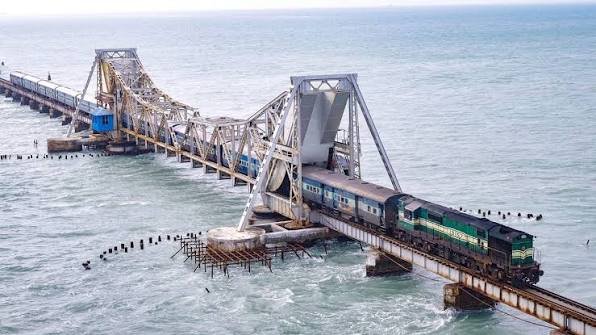
The name Pamban Bridge now represents two generations of railway engineering. The original bridge, commissioned in 1914, was India’s first sea bridge and became famous for its manually operated Scherzer rolling lift section. Its modern replacement, the New Pamban Bridge, was inaugurated on 6 April 2025. The 2.08-km structure is India’s first vertical-lift railway sea bridge and includes a central section that can rise to allow ships to pass through the navigational channel.
Alongside its transport role, Pamban Bridge has become one of the defining sights of a journey to Rameswaram. The open sea, fishing boats, railway structures and the parallel road bridge make this stretch unlike most railway crossings in India.
Quick Overview of Pamban Bridge
| Particular | Details |
| Name | Pamban Bridge/New Pamban Railway Bridge |
| Location | Ramanathapuram district, Tamil Nadu |
| Crosses | Palk Strait/Pamban sea channel |
| Connects | Mandapam mainland with Pamban Island and Rameswaram |
| Type | Vertical-lift railway sea bridge |
| New Bridge Length | About 2.08 km |
| Main Navigational Span | 72.5 metres |
| Vertical Lift | Up to 17 metres |
| New Bridge Inaugurated | 6 April 2025 |
| Original Railway Bridge Opened | 24 February 1914 |
| Constructed By | Rail Vikas Nigam Limited |
| Rail Configuration | Built for future dual-track requirements; single line initially |
| Parallel Road Crossing | Annai Indira Gandhi Road Bridge |
| Major Destination | Rameswaram |
| Known For | India’s first vertical-lift railway sea bridge and historic sea-rail connection |
Official railway information states that the new structure measures about 2.08 km and has 99 regular spans along with the 72.5-metre lift span.
Where is Pamban Bridge Located?
Pamban Bridge is located in Ramanathapuram district in southeastern Tamil Nadu. It crosses the sea between Mandapam on the Indian mainland and Pamban Island, also widely known as Rameswaram Island.
Once the bridge reaches the island side, the railway continues through Pamban towards Rameswaram town. This makes the bridge an important part of the route used by pilgrims visiting the famous Ramanathaswamy Temple and by tourists travelling farther towards Dhanushkodi.
The setting is particularly distinctive because three transport elements can be seen close together: the historic railway bridge, the new vertical-lift railway bridge and the parallel road bridge.
Pamban is therefore not simply a bridge location. It is the point where mainland rail and road connectivity enters one of India’s most important pilgrimage islands.
Pamban Bridge Route and Connectivity
The railway route across Pamban Bridge connects Mandapam with Pamban and Rameswaram. Trains approaching from mainland Tamil Nadu travel through Ramanathapuram and Mandapam before crossing the sea to enter Pamban Island.
Important connections associated with the bridge include:
- Mandapam: The mainland town immediately before the sea crossing.
- Pamban: The first important settlement on the island side of the bridge.
- Rameswaram: The principal pilgrimage and tourism centre reached after crossing Pamban.
- Ramanathapuram: A major district centre on the mainland route towards Rameswaram.
- Madurai: One of the main regional gateways for visitors travelling towards Ramanathapuram and Rameswaram.
- Dhanushkodi: Reached by road from Rameswaram after entering the island.
The inauguration of the new bridge also coincided with the launch of a Rameswaram–Tambaram service connecting Rameswaram with destinations including Ramanathapuram, Paramakudi, Manamadurai, Karaikudi, Tiruvarur, Villupuram, Chengalpattu and Tambaram.
Why is Pamban Bridge Important?
Pamban Bridge is important for a combination of geographical, religious, transport and engineering reasons.
Rameswaram is separated from mainland Tamil Nadu by the sea, so dependable transport links are essential for residents and visitors. The railway bridge gives Rameswaram direct access to the wider Indian Railways network and is especially significant for the large number of pilgrims visiting the island.
The bridge also supports the local economy. Rameswaram and Pamban depend heavily on pilgrimage tourism, fishing and related commercial activities. Better rail connectivity helps move passengers while supporting hotels, restaurants, shops and local transport services.
Its importance extends beyond transport. The original Pamban Bridge became part of India’s railway heritage, while the new bridge demonstrates how modern infrastructure can operate in a difficult marine environment while still permitting ships to use the channel below.
Rail Movement Across Pamban Bridge
Unlike an urban road bridge, traffic on Pamban Bridge consists primarily of scheduled railway services rather than cars, buses or two-wheelers.
The new bridge was constructed to support heavier and faster railway operations than its predecessor. Southern Railway states that the foundation uses 333 piles and 101 piers/pile caps, while the structure has been designed with provision for dual tracks in the future.
Rail operations also need to be coordinated with marine movement. When a vessel requiring additional clearance needs to pass through the navigational channel, the central lift span can be raised. This creates an unusual transport arrangement in which railway and marine traffic use the same narrow geographical crossing at different levels.
Passengers crossing by train get wide sea views, although the crossing itself is relatively short compared with the overall rail journey to Rameswaram.
The Original Pamban Bridge and Its Historic Importance
The story of Pamban Bridge began long before the present structure.
The original railway bridge was officially opened on 24 February 1914 and became India’s first sea bridge. For decades, it provided the only surface transport connection between Rameswaram Island and the mainland. A separate road bridge was added only in 1988.
One of the old bridge’s most remarkable features was its double-leaf Scherzer rolling lift span. The two sections could be opened to create a passage for ships travelling through the sea channel.
The combination of railway tracks, steel trusses, concrete piers and a movable central section made the bridge an important engineering achievement of its period.
More than a century of exposure to salt water, strong coastal winds and the demanding marine environment eventually made a replacement necessary. The Government of India sanctioned the new bridge project in 2019.
The historic bridge nevertheless remains central to the identity of Pamban. For generations of passengers, travelling slowly across the sea by train was one of the most memorable parts of reaching Rameswaram.
Engineering of the New Pamban Vertical-Lift Bridge
The new bridge introduces a completely different movable-span system.
Instead of the two leaves of the old rolling-lift design opening sideways, the new bridge has a 72.5-metre central span that rises vertically by as much as 17 metres. Raising the entire span creates the clearance required for larger ships to move through the channel.
The bridge is also around three metres higher than its predecessor. Its marine location required several measures intended to improve durability.
Major engineering features include:
- Stainless-steel reinforcement
- Fully welded joints
- High-grade protective coatings
- Special polysiloxane coating against marine corrosion
- 333 foundation piles
- 101 pile caps/piers
- 99 approach spans
- Provision for future double-track operation
- Electrification infrastructure
The bridge was built by Rail Vikas Nigam Limited (RVNL). Construction involved difficult work over water, strong currents, fishing activity and limited working space. PIB records also note that special methods had to be developed for launching and positioning the large lift span.
These features make the new Pamban Bridge considerably more than a replacement railway crossing. It is one of the most technically unusual railway bridges currently operating in India.
Pamban Road Bridge and Road Connectivity
Visitors sometimes use the term “Pamban Bridge” for the road crossing as well, but the railway and road bridges are separate structures.
The road crossing is officially known as the Annai Indira Gandhi Road Bridge. It was opened in 1988 and runs parallel to the railway bridges. The Ramanathapuram district administration describes the road bridge as approximately 2.2 km long.
Road travellers heading towards Rameswaram typically approach through:
Madurai → Paramakudi → Ramanathapuram → Mandapam → Pamban → Rameswaram
After crossing the road bridge, motorists can continue towards Rameswaram town and then farther towards Dhanushkodi.
Public and private buses, taxis and private vehicles regularly use this road connection. The national highway serving Rameswaram is now numbered NH-87, replacing the older NH-49 numbering found in some older tourism references.
Visiting and Viewing Pamban Bridge
For many visitors, the attraction is not simply crossing the bridge but seeing the railway structures against the open sea.
The parallel road bridge provides broad views towards the old and new railway bridges. Coastal areas around Pamban also offer views of fishing boats, railway spans and the lift towers.
Early morning and late afternoon are often visually attractive because the lower sunlight gives clearer definition to the steel structure and surrounding water. Weather conditions can change quickly, however, and this exposed sea crossing can become very windy.
Visitors should also remember that the new Pamban Bridge is operational railway infrastructure, not a pedestrian sightseeing bridge. The safest approach is to view it from permitted public areas rather than entering railway property.
Major Landmarks and Attractions Near Pamban Bridge
Several well-known places can be combined with a visit to the Pamban area:
- Ramanathaswamy Temple: Rameswaram’s best-known religious landmark and one of India’s major Shiva pilgrimage sites.
- Pamban Town: Fishing settlement located close to the island end of the bridges.
- Mandapam: Mainland gateway to the Pamban crossing.
- A.P.J. Abdul Kalam Memorial: Major visitor attraction in the Rameswaram area.
- Dhanushkodi: Abandoned historic settlement and popular coastal destination at the eastern end of the island.
- Rameswaram Railway Station: Main rail station serving the pilgrimage town.
- Agnitheertham: Important seafront religious site near Ramanathaswamy Temple.
The district tourism authority lists Rameswaram Railway Station close to the temple area, while Madurai is the principal airport gateway for many travellers visiting the district.
Nearby Areas to Pamban Bridge
- Mandapam: The mainland settlement at the western end of the Pamban crossing and an important road and railway gateway.
- Pamban: Located immediately after the bridge on Rameswaram Island and known for fishing and coastal activity.
- Rameswaram: The island’s main town and its most important pilgrimage and tourism centre.
- Ramanathapuram: Major mainland town and district headquarters on the route towards Mandapam.
- Dhanushkodi: Located beyond Rameswaram towards the southeastern end of the island and known for its dramatic coastal landscape and historic ruins.
FAQs About Pamban Bridge
Q1. Does the vertical lift section of Pamban Bridge open at a fixed time every day?
No fixed public sightseeing schedule is published for the lift operation. The span is raised when marine traffic requiring additional clearance needs to move through the navigational channel. Visitors should therefore not plan a trip on the assumption that the lift mechanism will operate at a particular sightseeing time.
Q2. Can tourists walk on the New Pamban Railway Bridge?
No. The new bridge is active railway infrastructure and should not be treated as a pedestrian attraction. Visitors can view it from public areas around Pamban and from the parallel road corridor without entering railway property.
Q3. Is Pamban Bridge the same as Ram Setu?
No. Pamban Bridge is a man-made railway crossing between mainland Tamil Nadu and Rameswaram Island. Ram Setu, also called Adam’s Bridge, refers to the chain of shoals extending from the Dhanushkodi side towards Mannar Island in Sri Lanka.
Q4. Can large ships pass through the Pamban channel without dismantling any part of the bridge?
Yes. The new bridge was specifically designed with a movable vertical section. The 72.5-metre span can be raised by up to 17 metres to create additional navigation clearance for vessels.
Q5. Does a traveller need to cross Pamban Bridge to reach Dhanushkodi?
Anyone approaching Rameswaram and Dhanushkodi by land from mainland India must first enter Pamban Island. Road travellers use the parallel Annai Indira Gandhi Road Bridge, while rail passengers reach the island through the New Pamban Railway Bridge before continuing their journey by road towards Dhanushkodi.