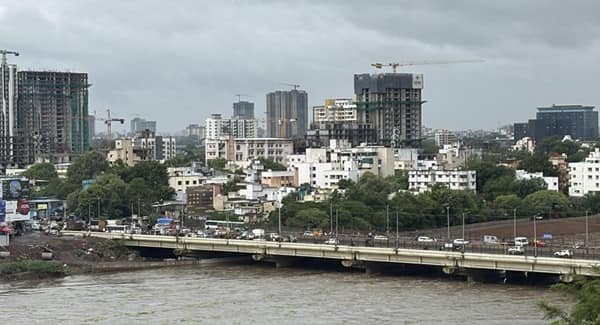
Delhi Signature Bridge is one of the capital’s most distinctive modern landmarks and an important road connection across the Yamuna River at Wazirabad. The asymmetrical cable-stayed bridge links the Wazirabad and Outer Ring Road side of North Delhi with Khajuri Khas and other parts of Northeast Delhi. Besides improving everyday commuting, its dramatic inclined pylon and cable arrangement have made it instantly recognisable on Delhi’s skyline.
The bridge was inaugurated in November 2018 and carries eight traffic lanes. The main bridge is 675 metres long and 35.2 metres wide, with a 251-metre principal span. Its pylon rises about 165 metres above ground, while the much-discussed viewing facility is located around the 154-metre level.
Signature Bridge is important not simply for its appearance. It provides a faster connection between North and Northeast Delhi and gives commuters from areas such as Khajuri Khas, Bhajanpura and Karawal Nagar more direct access towards Wazirabad, the Outer Ring Road and central parts of the capital.

Quick Overview of Delhi Signature Bridge
| Particular | Details |
| Name | Signature Bridge |
| Location | Wazirabad, Delhi |
| River | Yamuna River |
| Bridge Type | Asymmetrical cable-stayed road bridge |
| Total Length | 675 metres |
| Main Span | 251 metres |
| Width | 35.2 metres |
| Traffic Lanes | 8 lanes – four in each direction |
| Pylon Height | About 165 metres above ground |
| Opened | November 2018 |
| Owner/Original Project Agency | DTTDC |
| Current Maintenance Agency | Delhi PWD |
| Main Connection | Wazirabad–Khajuri Khas/Northeast Delhi |
| Western Approach | Outer Ring Road |
| Nearby Areas | Wazirabad, Khajuri Khas, Sonia Vihar, Bhajanpura and Timarpur |
| Viewing Gallery | Built but not open to the general public as of August 2026 |
| Known For | India’s first asymmetrical cable-stayed bridge and iconic inclined pylon |
The bridge engineering firm gives the wider infrastructure project, including approaches, a total length of approximately 6 km, so that figure should not be confused with the 675-metre length of the main bridge itself.
Where is Delhi Signature Bridge Located?
Signature Bridge crosses the Yamuna at Wazirabad in northern Delhi. Its western side connects with the Outer Ring Road network, while the eastern approach leads towards Khajuri Khas and the densely populated neighbourhoods of Northeast Delhi.
The location is particularly significant because the Yamuna separates large residential areas of Northeast Delhi from North and Central Delhi. Before the new bridge opened, a considerable share of traffic depended on older crossings and already congested routes around Wazirabad.
The District North East administration identifies Signature Bridge as a major tourist and transport landmark and places it about 9 km by road from the ISBT area. It can be approached by cab, auto-rickshaw or e-rickshaw in addition to regular road transport.
Delhi Signature Bridge Route and Road Connectivity
Signature Bridge creates an important east-west connection across the Yamuna.
Major route connections include:
- Wazirabad: The principal North Delhi locality on the western side of the bridge.
- Outer Ring Road: Major arterial route providing onward access towards Burari, Timarpur, Majnu Ka Tila and other parts of Delhi.
- Khajuri Khas: One of the main Northeast Delhi junctions served by the eastern approach.
- Bhajanpura: Major residential and commercial locality connected through the Khajuri Khas road network.
- Karawal Nagar: Large Northeast Delhi residential area that benefits from the bridge connection.
- Sonia Vihar: Located along the eastern Yamuna-side road network.
- Burari: Accessible through the Wazirabad and Outer Ring Road side.
- Central Delhi: Commuters can continue towards areas such as ITO through the wider Ring Road network.
- Ghaziabad and Loni side: The bridge is useful for selected journeys between Northeast Delhi, neighbouring Uttar Pradesh and central parts of Delhi.
The bridge was developed specifically to improve movement between North and Northeast Delhi and reduce pressure on older Yamuna crossings.
Why is Delhi Signature Bridge Important?
Signature Bridge combines transport infrastructure and landmark architecture in a way few Delhi bridges do.
Its most practical role is improving road connectivity. When it opened, transport planners expected the eight-lane crossing to reduce pressure on the Wazirabad and Ring Road corridors and improve travel for residents of North and Northeast Delhi.
The bridge is useful for:
- Daily office commuters
- Residents of Northeast Delhi
- Traffic travelling towards North Delhi
- Cars and buses using Outer Ring Road
- Vehicles travelling between Delhi and the Loni/Ghaziabad side
- Local traffic from Khajuri Khas and Bhajanpura
- Visitors interested in Delhi’s modern architecture
The structural design itself is another reason for its importance. Government information describes Signature Bridge as India’s first asymmetrical cable-stayed bridge.
Traffic Conditions at Delhi Signature Bridge
Signature Bridge carries substantial city traffic, especially during weekday commuting periods.
The western side feeds into the busy Outer Ring Road and Wazirabad network, while the eastern side handles vehicles from Khajuri Khas, Bhajanpura, Karawal Nagar and nearby areas. Congestion therefore often depends as much on the roads approaching the bridge as on the bridge deck itself.
Traffic is generally more likely to slow during:
- Morning and evening office hours
- Heavy congestion at Khajuri Khas
- Delays on Outer Ring Road
- Road or utility work around Wazirabad Road
- Major events and traffic diversions
- Heavy rain or high Yamuna levels
The bridge can also become particularly important when older crossings are restricted. During severe Yamuna flooding in September 2025, for example, the Old Wazirabad Bridge was closed and traffic diversions were introduced around the Signature Bridge-Wazirabad area.
For normal journeys, drivers should therefore consider traffic conditions on both approaches rather than judging travel time only by the length of the bridge.
Engineering and Design of Signature Bridge
Signature Bridge is a cantilever-spar cable-stayed bridge distinguished by its highly unusual pylon.
The engineering firm schlaich bergermann partner describes the pylon as two inclined columns that bend midway. Stay cables extend from the upper structure in a harp-like arrangement to support the bridge deck.
Important engineering figures include:
- Bridge length: 675 metres
- Main span: 251 metres
- Width:2 metres
- Traffic configuration: four lanes in each direction
- Pylon height: 165 metres above ground
- Deck area: approximately 25,000 sq metres
- Upper steel-glass tip: around 30 metres high
The pylon is intentionally asymmetric. Its weight and geometry help counterbalance forces created by the bridge deck and cables rather than simply acting as a conventional vertical tower.
Illumination of the upper steel-and-glass portion also gives the structure its distinctive appearance after dark.
Signature Bridge Viewing Gallery: Is It Open?
The viewing gallery is one of the most misunderstood features of Signature Bridge.
The original tourism plan included a viewing deck high within the pylon, reached through specially designed inclined lifts. However, the gallery has never been opened to the general public. Regulatory and technical issues prevented the unusual inclined lift system from receiving the necessary clearances for tourist use.
Four lifts were installed: two operating at approximately 60-degree inclinations and two at around 80 degrees. They were used for maintenance purposes rather than taking tourists to the observation level.
There was an important development in May 2026, when the Delhi government began repair work and trial runs to evaluate whether the long-unused lift system could eventually be made operational. Officials said technical condition and safety requirements still needed to be assessed.
Therefore, as of August 2026, visitors should not plan a trip expecting access to the 154-metre viewing gallery.
Current Maintenance and Upgradation Plans
Maintenance responsibility for Signature Bridge has recently changed.
The bridge was originally developed and maintained by the Delhi Tourism and Transportation Development Corporation (DTTDC). By 2026, upkeep responsibility had shifted to the Public Works Department (PWD).
In March 2026, PWD began the process of preparing a comprehensive five-year maintenance programme.
The planned assessment covers:
- Superstructure and substructure
- Stay cables
- Bearings
- Expansion joints
- Steel deck and pylon
- Glass façade
- Skywalk ramp
- Bridge-health monitoring equipment
- Electrical and associated infrastructure
The plan is intended to introduce scheduled inspections, preventive maintenance and procedures for responding to unexpected structural problems.
The work is particularly important because Signature Bridge is both a heavily used transport structure and an architecturally complex landmark.
Signature Bridge as a Delhi Landmark
The bridge was intentionally designed to be more than a functional Yamuna crossing.
Its inclined pylon rises dramatically above the comparatively flat river landscape, making it visible from a considerable distance. The upper 30-metre steel-and-glass portion can be illuminated, reinforcing its role as a nighttime landmark.
Its architecture has also made the bridge popular for photography. However, motorists should treat it first as an active eight-lane road rather than as a sightseeing platform.
The safest approach is to enjoy external views of the structure from permitted locations rather than stopping in live traffic lanes for photographs.
Public Transport Near Delhi Signature Bridge
Road-based public transport is the main way of reaching the bridge area.
The District North East administration specifically notes access by:
- Cabs
- Auto-rickshaws
- E-rickshaws
Delhi buses also serve the surrounding Wazirabad, Khajuri Khas, Bhajanpura and Northeast Delhi road network.
For interstate and longer-distance bus travellers, the government tourism listing places Signature Bridge approximately 9 km from the ISBT area. New Delhi Railway Station is listed at about 16 km from the attraction.
There is no need for visitors to reach the viewing gallery to see the bridge; the structure itself is visible from the surrounding Yamuna and approach-road areas.
Major Landmarks and Places Near Signature Bridge
Important places around the bridge include:
- Wazirabad: Historic Yamuna-side locality immediately associated with the crossing.
- Wazirabad Barrage: Major water-control structure close to the bridge.
- Yamuna River: The river crossed by Signature Bridge.
- Khajuri Khas: Major Northeast Delhi junction on the eastern approach.
- Sonia Vihar: Residential area along the eastern Yamuna side.
- Majnu Ka Tila: Well-known locality accessible through the Ring Road corridor.
- Timarpur: North Delhi locality near the wider Wazirabad road network.
- Bhajanpura: Large Northeast Delhi residential and commercial area.
The bridge is therefore useful both as a road connection and as a navigation landmark between northern and northeastern parts of the capital.
Nearby Areas to Delhi Signature Bridge
- Wazirabad: The principal locality on the western side and one of the bridge’s main road-access points.
- Khajuri Khas: Important junction on the eastern side serving several Northeast Delhi neighbourhoods.
- Sonia Vihar: Residential locality close to the Yamuna and the eastern bridge network.
- Bhajanpura: Dense residential and commercial area connected through Wazirabad Road and Khajuri Khas.
- Burari: Large North Delhi locality accessible through the Outer Ring Road side.
- Timarpur: Established North Delhi neighbourhood located within the wider Wazirabad catchment.
- Karawal Nagar: Major Northeast Delhi residential area that benefits from improved cross-Yamuna connectivity.
FAQs About Delhi Signature Bridge
Q1. Can tourists currently go to the top of Signature Bridge?
No. The high-level viewing gallery has never opened to the general public because the inclined lifts did not receive the required approvals. Lift testing and restoration work restarted in 2026, but public access had not begun as of August 2026.
Q2. Is Signature Bridge open for normal vehicle traffic?
Yes. The bridge remains an important eight-lane road crossing connecting Wazirabad with Northeast Delhi. Current government maintenance work is focused on preserving and inspecting the structure rather than replacing it.
Q3. Is Signature Bridge the same as Old Wazirabad Bridge?
No. They are separate Yamuna crossings. Signature Bridge is the modern cable-stayed structure opened in 2018, while Old Wazirabad Bridge is an older crossing nearby. During closures of the older bridge, Signature Bridge may be used as an alternative route.
Q4. Why does one source give the pylon height as 165 metres while another mentions 154 metres?
The engineering designer gives the overall pylon height as 165 metres above ground. Government tourism references commonly use 154 metres for the level associated with the viewing facility/pylon landmark measurement. The figures therefore describe slightly different reference points rather than necessarily contradicting each other.
Q5. Is another bridge planned near Signature Bridge?
Delhi authorities were examining additional Yamuna-crossing options in 2026, including the possibility of a new bridge near Signature Bridge. The proposal was still at the feasibility-study stage, so it should not be treated as an approved replacement or extension of the existing bridge.