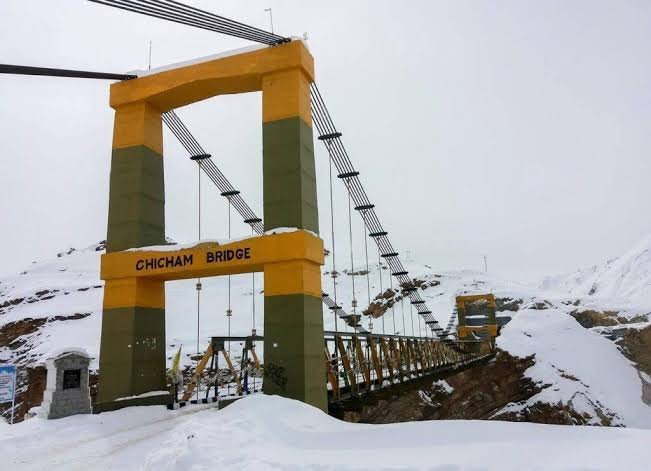
Chicham Bridge is one of the most striking road landmarks in Spiti Valley, Himachal Pradesh. Located high in the Trans-Himalayan landscape of Lahaul and Spiti district, the bridge crosses the deep Samba Lamba gorge and provides a direct road connection between the Kibber and Chicham sides of the valley.
Completed in 2017, Chicham Bridge transformed local connectivity in a part of Spiti where crossing the gorge had once been difficult and time-consuming. Before the bridge was built, residents of Chicham depended on a ropeway for direct movement across the gorge or had to make a much longer journey by road. The permanent crossing made travel between the villages easier while also improving the route towards Kiato, Losar and the Kunzum Pass side.
The bridge is popularly promoted as the highest bridge in Asia, largely because it stands at an altitude of roughly 4,145 metres, or 13,596 feet, above sea level. More precisely, its fame comes from its extremely high geographical elevation rather than having the world’s greatest vertical drop beneath a bridge deck.
Quick Overview of Chicham Bridge
| Particular | Details |
| Name | Chicham Bridge |
| Location | Spiti Valley, Himachal Pradesh |
| District | Lahaul and Spiti |
| Connects | Kibber and Chicham sides |
| Crosses | Samba Lamba gorge/nallah |
| Altitude | Around 4,145 metres or 13,596 feet |
| Bridge Span | Around 114 metres |
| Completed | 2017 |
| Bridge Type | High-altitude road bridge |
| Constructed By | Border Roads Organisation |
| Nearest Major Town | Kaza |
| Nearby Villages | Kibber and Chicham |
| Major Onward Route | Kiato-Losar-Kunzum Pass side |
| Known For | Extremely high altitude, dramatic gorge views and Spiti road connectivity |
Specialist bridge records place the main span at approximately 114 metres, while the bridge deck itself is roughly 150 metres above the lower part of the gorge.
Where is Chicham Bridge Located?
Chicham Bridge is located in the upper Spiti region of Himachal Pradesh, north of Kaza and close to Kibber village.
Chicham itself is a small high-altitude settlement separated from Kibber by a deep gorge. A local accommodation listing places Chicham about 5 km from Kibber and around 27 km north of Kaza, although the actual driving distance varies depending on the exact starting point and road used.
Visitors commonly approach the bridge from Kaza through the Key Monastery and Kibber side. After Kibber, the road continues towards Chicham Bridge before reaching Chicham village.
The landscape around the bridge is characteristically Spitian: steep barren mountains, deep valleys, exposed rock formations and very little vegetation. Its remote setting is a major part of the attraction.
Chicham Bridge Route and Road Connectivity
The most popular visitor route is:
Kaza → Key Monastery → Kibber → Chicham Bridge → Chicham
This route allows travellers to combine several of upper Spiti’s major attractions in a single circuit.
Important road connections include:
- Kaza: Main administrative and tourism centre of Spiti and the usual base for visiting the bridge.
- Key Monastery: One of Spiti’s best-known Buddhist monasteries and a natural stop on the Kaza-Kibber route.
- Kibber: High-altitude village located immediately before the bridge when approaching from Kaza.
- Chicham: Village situated beyond the bridge.
- Kiato: Important road junction connecting the Chicham side with the main Kaza-Manali corridor.
- Losar: Major settlement farther towards Kunzum Pass.
- Kunzum Pass: High mountain pass on the route between Spiti and the Lahaul-Manali side when seasonal road conditions permit.
- Chandratal: Popular high-altitude lake reached through the Batal side during the accessible season.
One of the bridge’s practical benefits is that travellers moving from Kibber towards Losar no longer need to make the much longer detour that existed before the direct Chicham crossing. Published accounts put the saving at around 40 km.
Why is Chicham Bridge Important?
Chicham Bridge matters more to Spiti than its tourism photographs might suggest.
The gorge between Chicham and Kibber created a serious physical barrier for local residents. Before the permanent road bridge existed, a ropeway was used for direct movement across the gap. Vehicles could not simply cross from one village to the other.
Completion of the bridge created a dependable road connection and improved access between settlements in this remote part of the valley.
Its benefits include:
- Shorter road journeys between Kibber and the Chicham side
- Better access for local residents
- Improved movement of essential goods
- Easier vehicle access to Chicham village
- Better tourism connectivity
- A more direct link towards Kiato and the Losar side
The bridge has also become an important tourism landmark. Travellers who once visited Kibber mainly for the village and nearby wildlife landscape now commonly extend their trip to Chicham Bridge.
Traffic Conditions at Chicham Bridge
Traffic at Chicham Bridge is very different from congestion at major city bridges.
There are no large daily traffic volumes comparable with urban bridges in Pune, Mumbai or Bengaluru. Most movement consists of local vehicles, taxis, motorcycles, tourist SUVs and other vehicles travelling through upper Spiti.
However, traffic can become temporarily concentrated around the bridge during the main tourism season because many visitors stop for photographs and views.
The bigger travel issue is usually road condition rather than traffic volume.
Mountain roads around Spiti may be affected by:
- Snowfall
- Landslides and rockfall
- Road-repair work
- Loose gravel
- Water crossings
- Sudden weather changes
- Narrow road sections
- Seasonal closure of high mountain passes
The Lahaul and Spiti district administration warns that much of the district remains snow-covered for a significant part of the year and maintains a changing road-status advisory. As of 6 August 2026, its published status still listed the Keylong-Kaza route as closed, illustrating why visitors should check conditions immediately before attempting the full Manali-Spiti circuit.
Local access from Kaza towards Kibber and Chicham can have different conditions from the distant Keylong-Kaza route, so one closure should not automatically be interpreted as meaning that Chicham Bridge itself is inaccessible.
Engineering and High-Altitude Significance
Building a road bridge in Spiti presents challenges very different from construction in a plain or urban environment.
Chicham sits above 4,000 metres, where winter temperatures can become severe and the construction season is restricted by snow and weather. Moving machinery, steel, concrete and other materials into such remote terrain also requires considerable logistical effort.
The bridge took many years to complete and was finally opened in 2017. It is generally credited to the Border Roads Organisation, which undertakes strategic road development in difficult Himalayan terrain.
The principal span is approximately 114 metres. Specialist bridge data places the road deck roughly 150 metres above the gorge below.
Its significance therefore comes from a combination of three factors: extreme geographical altitude, difficult construction conditions and the practical connectivity it provides to remote communities.
Is Chicham Really Asia’s Highest Bridge?
The phrase “Asia’s highest bridge” appears almost everywhere in tourism descriptions of Chicham Bridge, but it requires some explanation.
Chicham Bridge stands at approximately 4,145 metres above mean sea level, which makes its geographical elevation exceptional. That is the basis for most claims describing it as Asia’s highest bridge.
However, bridge engineers normally distinguish between:
Elevation above sea level: How high the entire bridge location is geographically.
Deck height: The vertical distance between the bridge deck and the land or water directly below.
Specialist bridge records note that Chicham’s deck is roughly 150 metres above the gorge, meaning there are other bridges in Asia with much greater deck heights over valleys or rivers.
Therefore, describing Chicham as one of the world’s highest-altitude road bridges is more precise than assuming it has the world’s or Asia’s greatest bridge-deck height.
This distinction does not reduce its engineering or tourism significance. A motorable bridge operating at more than 4,100 metres above sea level remains highly unusual.
The Story Before Chicham Bridge
One of the most interesting aspects of Chicham Bridge is understanding what existed before it.
Chicham and Kibber are geographically close, but the deep gorge between them made direct movement extremely difficult. For local residents, the solution was an aerial ropeway or cable crossing over the gorge.
A present-day Chicham homestay description recalls that the cable system across the approximately 110-metre gorge was once the direct way of reaching the settlement before road access improved.
The bridge changed that relationship completely.
Today, a vehicle can travel directly across a gap that once separated neighbouring communities. This transformation is arguably more important than the “highest bridge” tourism label because it shows how a relatively short bridge can dramatically change everyday accessibility in mountainous terrain.
Public Transport Near Chicham Bridge
Public transport around Chicham Bridge is limited compared with urban or more densely populated tourist destinations.
Kaza is the main transport base for visitors. From Kaza, travellers commonly use:
- Local taxis
- Shared taxis when available
- Tourist SUVs
- Motorcycles
- Private vehicles
Regular city-style bus services should not be expected directly at the bridge.
Travellers depending entirely on public transport should plan more carefully because services in upper Spiti can be limited and seasonal. Taxi arrangements from Kaza are generally more practical for combining Key Monastery, Kibber and Chicham Bridge during a single outing.
Major Landmarks and Attractions Near Chicham Bridge
Several major Spiti attractions can be combined with a trip to the bridge:
- Chicham Village: Remote high-altitude settlement immediately beyond the bridge.
- Kibber Village: Famous mountain village near the bridge and a common stop on Spiti itineraries.
- Key Monastery: Major Tibetan Buddhist monastery between Kaza and Kibber.
- Kibber Wildlife Sanctuary: Large protected high-altitude landscape associated with Himalayan wildlife, including the snow leopard.
- Kaza: Main town and tourism base for central Spiti.
- Komic: Famous high-altitude village in the wider Kaza region.
- Hikkim: Known particularly for its high-altitude post office.
- Langza: Scenic village famous for its Buddha statue, fossils and mountain views.
The combination of Key Monastery, Kibber and Chicham Bridge makes this one of the most popular short sightseeing circuits from Kaza.
Nearby Areas to Chicham Bridge
- Chicham: The closest settlement and the village from which the bridge gets its name.
- Kibber: Located across the gorge and one of the most famous villages in upper Spiti.
- Key: Known primarily for Key Monastery and located along the usual route from Kaza.
- Kaza: The principal town of Spiti and the main base for accommodation, fuel, food and local travel arrangements.
- Kiato: Road junction useful for onward travel towards the Kaza-Manali highway corridor.
- Losar: High-altitude settlement on the route towards Kunzum Pass.
FAQs About Chicham Bridge
Q1. Is there an entry fee to visit Chicham Bridge?
There is generally no separate sightseeing ticket simply for driving across or viewing Chicham Bridge. It functions as an operational public road bridge rather than a ticketed tourist attraction.
Q2. Can travellers visit Chicham Bridge during winter?
Winter access depends heavily on snowfall and local road conditions. Kaza and parts of Spiti can remain accessible from the Shimla-Kinnaur side during periods when the Manali route is closed, but roads towards individual high-altitude villages can still be affected by snow. Current district or police road advisories should be checked before travelling.
Q3. Is a permit required specifically for Chicham Bridge?
There is no special bridge-entry permit simply for visiting Chicham Bridge. However, permit and identification requirements for travelling through parts of the wider Spiti and Kinnaur region can vary according to nationality and route.
Q4. Are fuel stations available at Chicham Bridge?
Travellers should not depend on finding fuel at the bridge or in tiny nearby villages. Kaza is the main practical service centre in this part of Spiti, so vehicles should carry adequate fuel before heading into remote routes.
Q5. Can Chicham Bridge be covered together with Key Monastery and Kibber?
Yes. This is one of the most practical ways to visit it. Key Monastery and Kibber lie along the commonly used route from Kaza towards Chicham, allowing all three places to be combined in the same local sightseeing circuit.