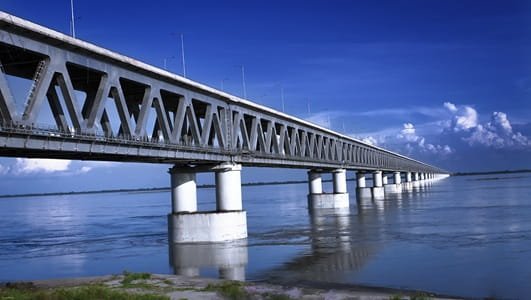
Bogibeel Bridge is one of the most important transport and engineering landmarks in Northeast India. Built across the Brahmaputra River in Assam, the 4.94-km-long bridge connects Dibrugarh district on the south bank with Dhemaji district on the north bank. What makes the structure especially significant is its double-deck design: it carries road vehicles on the upper level and railway traffic on the lower level.
Bogibeel is officially recognised as India’s longest rail-cum-road bridge. It has transformed connectivity between Upper Assam and the northern bank of the Brahmaputra while also providing a much faster link towards Arunachal Pradesh. The bridge was inaugurated on December 25, 2018, and has since become important for passenger travel, freight movement, tourism and strategic transportation.
Apart from its transport role, Bogibeel Bridge is notable for its huge welded steel-truss structure and its ability to operate in an area exposed to strong winds, floods and seismic activity. The Assam government also promotes the bridge and Bogibeel Ghat as a tourism attraction in the Dibrugarh region.
Quick Overview of Bogibeel Bridge
| Particular | Details |
| Name | Bogibeel Bridge |
| Location | Assam |
| River | Brahmaputra River |
| Connects | Dibrugarh and Dhemaji districts |
| Bridge Type | Double-deck rail-cum-road bridge |
| Total Length | 4.94 km |
| Road Deck | Upper deck |
| Railway Deck | Lower deck |
| Railway Provision | Double broad-gauge railway line |
| Road Provision | Three-lane road |
| Main Span Arrangement | 39 major spans of 125 metres |
| Opened | December 25, 2018 |
| Nearby Areas | Dibrugarh, Bogibeel Ghat, Dhemaji and Silapathar |
| Known For | India’s longest rail-cum-road bridge |
| Major Importance | Upper Assam, Arunachal Pradesh and defence connectivity |
Indian Railways records confirm the bridge’s 4.94-km length, while government information identifies it as the country’s longest rail-cum-road bridge.
Where is Bogibeel Bridge Located?
Bogibeel Bridge crosses the Brahmaputra in Upper Assam, connecting the Dibrugarh district side of the river with Dhemaji district on the northern bank. The bridge lies downstream of Dibrugarh city and provides direct access between two regions that were historically separated by the enormous width of the Brahmaputra.
Dibrugarh is one of Upper Assam’s most important commercial, medical and educational centres. On the northern side, the bridge provides access towards Dhemaji, Silapathar and routes leading farther into Arunachal Pradesh.
Before the bridge opened, crossing the Brahmaputra in this part of Assam involved ferry services or much longer road and rail journeys using distant bridges. Bogibeel therefore fundamentally changed everyday movement between the north and south banks.
Bogibeel Bridge Route and Road Connectivity
The road deck of Bogibeel Bridge provides an important link between the Dibrugarh side of Upper Assam and the Dhemaji-Silapathar side north of the Brahmaputra.
Important connections include:
- Dibrugarh: Major commercial and educational centre on the south bank and one of the principal cities served by the bridge.
- Dhemaji: Important district headquarters accessible through the northern road network.
- Silapathar: Major commercial town whose connectivity with Dibrugarh improved substantially after the bridge opened. The Dhemaji district administration specifically notes Bogibeel Bridge as important to Silapathar’s commercial links with Dibrugarh.
- Pasighat: Accessible through onward routes into Arunachal Pradesh from the north-bank side.
- Itanagar: The bridge significantly shortens journeys between the Dibrugarh region and Arunachal Pradesh.
- Tinsukia: Major Upper Assam city connected through the road and railway network on the Dibrugarh side.
- North Lakhimpur: Accessible through the north-bank road corridor from Dhemaji.
Government information released after completion of the bridge stated that the journey between Itanagar and Dibrugarh was reduced to around 180 km, dramatically improving connectivity between eastern Assam and Arunachal Pradesh.
Why is Bogibeel Bridge Important?
Bogibeel Bridge solved a major transport problem created by the Brahmaputra.
The river is extremely wide in Upper Assam, and for decades communities on opposite banks could be geographically close but require lengthy journeys to reach each other. Bogibeel created a permanent road and rail crossing in a region where dependable connectivity had long been difficult.
The bridge benefits residents travelling for employment, education, healthcare and business. It has also strengthened commercial movement between Dibrugarh and north-bank towns such as Silapathar and Dhemaji.
Its importance extends beyond Assam. The crossing provides much easier access towards parts of Arunachal Pradesh, giving the bridge considerable economic and strategic significance for the wider Northeast. Government sources have repeatedly highlighted the improvement it brought to Assam-Arunachal connectivity.
Traffic Conditions at Bogibeel Bridge
Bogibeel Bridge carries a mixture of local cars, two-wheelers, buses and commercial vehicles on its upper road deck. Unlike many urban flyovers, its main purpose is not to bypass a congested city junction but to provide a long-distance river crossing between two large regional road networks.
Traffic volumes can increase during holidays, festivals and periods of heavy regional movement. The bridge is particularly important for motorists travelling between Dibrugarh and the northern-bank districts because there is no comparable nearby crossing offering the same direct connection.
Weather also matters in this part of Assam. The Brahmaputra region experiences heavy monsoon conditions, while the structure itself was engineered for demanding environmental conditions. India’s official tourism portal states that Bogibeel Bridge was designed to withstand winds of up to 260 kmph as well as significant seismic activity.
Because trains and road vehicles occupy separate decks, railway operations do not require normal road traffic to stop whenever a train crosses.
Double-Deck Rail and Road Design
The defining feature of Bogibeel Bridge is its double-deck configuration.
The upper deck is used by road vehicles, while the lower level carries railway tracks. The bridge was designed for a double broad-gauge railway line below and a three-lane roadway above.
This arrangement allows the same river-crossing structure to provide two different forms of transport without forcing road and railway traffic onto the same level.
The superstructure uses composite welded steel truss girders. Steel Authority of India Limited supplied plates, structural steel and reinforcement material for the project and described the bridge as a 4.94-km structure using composite welded steel trusses.
The bridge includes 39 major girder spans of about 125 metres each, an enormous structural arrangement needed to cross the broad Brahmaputra channel.
Railway Connectivity Through Bogibeel Bridge
Bogibeel Bridge created an equally important railway connection between the two banks of the Brahmaputra.
Its railway infrastructure links the rail network around Dibrugarh on the south bank with the north-bank railway system serving Dhemaji, North Lakhimpur and onward destinations.
When the bridge was inaugurated in December 2018, an intercity train connecting Tinsukia and Naharlagun was also flagged off, demonstrating the bridge’s importance for rail connectivity towards Arunachal Pradesh.
The railway connection means passengers and freight no longer need to make the large detours that were once necessary to cross the Brahmaputra by rail in this part of Assam.
For Upper Assam, this combination of road and railway connectivity is one of the bridge’s greatest long-term advantages.
Strategic Importance of Bogibeel Bridge
Bogibeel Bridge also has major strategic importance because of its location close to Arunachal Pradesh.
Improved road and railway connectivity allows personnel, equipment and supplies to move more efficiently between the south and north banks of the Brahmaputra and towards areas near India’s northeastern frontier.
Official tourism information describes the bridge as an important part of India’s defence infrastructure and notes its role in moving defence personnel and supplies towards the border region.
This strategic role influenced the robust engineering standards used for the structure. Bogibeel is therefore not simply a regional commuter bridge; it is also an important component of Northeast India’s wider transport network.
Construction and History of Bogibeel Bridge
The demand for improved Brahmaputra connectivity in Upper Assam has a long history.
The Bogibeel project was sanctioned in 1997-98, and its development extended over many years because of the scale and difficulty of constructing a nearly five-kilometre bridge across one of India’s largest rivers.
The bridge was finally dedicated to the nation on December 25, 2018. Indian Railways subsequently described its completion as one of the major infrastructure achievements in the Northeast.
The project involved extensive foundation work in the Brahmaputra riverbed and the fabrication and erection of large welded steel truss spans.
Its construction also had to account for the constantly changing river environment, high flood levels and seismic conditions found in Northeast India.
Bogibeel Bridge as a Tourist Attraction
Although Bogibeel Bridge was built primarily for transportation, it has also become a recognised tourism landmark.
The Dibrugarh district administration lists Bogibeel Bridge and Bogibeel Ghat among local tourist attractions. The immense width of the Brahmaputra and the long steel structure make the area particularly striking during clear weather and around sunset.
Tourism-related infrastructure has also developed around Bogibeel. In 2022, the Ministry of Ports, Shipping and Waterways announced development projects in the region and inaugurated the Bogibeel Riverfront Passenger Jetty while laying foundations for additional floating jetties.
This has helped establish Bogibeel as more than a transport crossing, with the riverfront gradually gaining importance for leisure and passenger-waterway activity.
Public Transport Near Bogibeel Bridge
Road and rail public transport both benefit from the bridge.
Assam State Transport Corporation route information includes services connecting areas such as Jorhat and Dhemaji via Bogibeel Bridge, demonstrating its use by regional bus services.
Taxis and other local vehicles are available from the Dibrugarh side for travel towards the bridge and adjoining areas.
Rail passengers use the lower deck as part of the wider railway network connecting Dibrugarh with the north bank and Arunachal Pradesh-bound routes.
This combination of bus, road and railway connectivity is unusual and is one reason Bogibeel is such an important regional transport structure.
Major Landmarks Near Bogibeel Bridge
Important places and facilities in the wider area include:
- Bogibeel Ghat: Riverfront area closely associated with the bridge.
- Bogibeel Riverfront Passenger Jetty: Developed to support passenger and riverfront activity.
- Dibrugarh: Major city and commercial centre south of the Brahmaputra.
- Silapathar: Important town on the northern side with strong trade links to Dibrugarh.
- Dhemaji: District headquarters connected through the north-bank road network.
- Brahmaputra River: The enormous river crossed by the bridge and the dominant geographical feature of the region.
Nearby Areas to Bogibeel Bridge
- Dibrugarh: The major city on the south-bank side and an important centre for business, healthcare, education and transportation.
- Bogibeel Ghat: Located close to the bridge and increasingly associated with riverfront and tourism activities.
- Silapathar: Important commercial town on the northern side whose connectivity with Dibrugarh has benefited significantly from the bridge.
- Dhemaji: Major north-bank district centre reached through the road network beyond Bogibeel.
- North Lakhimpur: Important town farther west along the north-bank corridor.
- Pasighat: Major Arunachal Pradesh destination accessible through onward road connections from the north-bank side.
FAQs About Bogibeel Bridge Assam
Q1. Can private cars and motorcycles cross Bogibeel Bridge?
Yes. The upper deck is designed for road traffic and is used by cars, motorcycles, buses and other permitted road vehicles. Railway traffic runs separately on the lower deck.
Q2. Do trains and road vehicles use the same surface?
No. Bogibeel has separate levels. Road vehicles use the upper deck, while the railway tracks are located on the lower deck.
Q3. Does Bogibeel Bridge help travellers going to Arunachal Pradesh?
Yes. One of the bridge’s major benefits is its much shorter road and rail connection from Upper Assam towards Arunachal Pradesh, including routes towards Pasighat, Naharlagun and Itanagar.
Q4. Is Bogibeel only a transport bridge, or can tourists visit the area?
The bridge is an operational transport structure, but the surrounding Bogibeel Bridge and Bogibeel Ghat area is officially promoted as a tourist attraction. Riverfront and passenger-jetty facilities have also been developed nearby.
Q5. Why was a rail-cum-road bridge chosen instead of separate bridges?
Using a double-deck structure allowed both railway and road links to cross the same difficult Brahmaputra corridor. This gave the project much wider regional value by improving passenger, freight and strategic connectivity through a single major crossing.