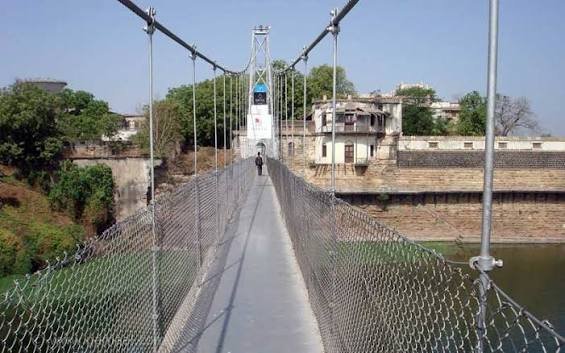
Morbi Bridge, popularly known as Jhulto Pul or the Morbi Suspension Bridge, was one of Gujarat’s best-known heritage pedestrian bridges. Built across the Machchhu River in Morbi city, the narrow suspension bridge connected the historic Darbargadh Palace side with the area around Lakhdhirji Engineering College. For more than a century, it was both a practical pedestrian link and one of Morbi’s most recognisable landmarks.
The bridge was inaugurated in 1879 during the reign of Sir Waghji Ravaji, the ruler of the former princely state of Morbi. The Morbi district administration records the structure as 233 metres long and only 1.25 metres wide, demonstrating how different it was from a conventional road bridge.
Its history changed permanently on 30 October 2022, when the suspension bridge collapsed into the Machchhu River only days after reopening following renovation. The disaster killed 135 people. The bridge has not returned to public use, and later reporting said its remains were removed and no replacement bridge had been opened at the site.
Quick Overview of Morbi Bridge
| Particular | Details |
| Name | Morbi Bridge |
| Popular Name | Jhulto Pul/Morbi Suspension Bridge |
| Location | Morbi, Gujarat |
| River | Machchhu River |
| Bridge Type | Pedestrian suspension bridge |
| Length | 233 metres |
| Width | 1.25 metres |
| Inaugurated | 1879 |
| Associated Ruler | Sir Waghji Ravaji |
| Connected | Darbargadh Palace and Lakhdhirji Engineering College side |
| Vehicle Traffic | Pedestrian bridge; not a regular vehicular crossing |
| Collapsed | 30 October 2022 |
| Deaths in Collapse | 135 |
| Current Status | Original bridge no longer operational |
| Known For | Heritage suspension design and the 2022 bridge tragedy |
The dimensions are still listed by the Morbi district administration, which describes the old bridge as an engineering landmark created using advanced European technology available at the time.
Where is Morbi Bridge Located?
Morbi Bridge was located in the centre of Morbi city in western Gujarat, crossing the Machchhu River. Morbi lies roughly 60 km from Rajkot and developed on both banks of the river.
Historically, the bridge connected the Darbargadh Palace area on one side with what is now the Lakhdhirji Engineering College side on the opposite bank. This placed it within Morbi’s old urban and royal precinct rather than on a major intercity highway.
The suspension bridge was therefore different from most bridges in this series. It was primarily a pedestrian crossing and heritage attraction, not an arterial road carrying cars, buses or commercial vehicles.
The bridge site also lies close to several historic parts of Morbi, including Green Chowk and the older palace area.
Morbi Bridge Route and Local Connectivity
Before its collapse, Jhulto Pul offered a direct pedestrian connection across the Machchhu River between two central parts of Morbi.
The bridge itself did not carry regular motor traffic because its deck was only 1.25 metres wide. People crossed it mainly on foot while moving between the Darbargadh side and the opposite riverbank.
Important connections around the former bridge include:
- Darbargadh Palace: Historic royal complex beside one end of the old crossing.
- Lakhdhirji Engineering College: Located on the opposite side of the river from the Darbargadh end.
- Green Chowk: Historic central square and one of Morbi’s notable architectural areas.
- Morbi city centre: Commercial and residential streets surrounding the old heritage district.
- Samakantha: Locality on the opposite side of the Machchhu associated with the bridge.
- Morbi Railway Station: Main railway facility serving the city.
- Rajkot Road: Important regional route linking Morbi with Rajkot and the wider Saurashtra road network.
Since the suspension bridge is no longer available, local movement across the Machchhu depends on other operational city roads and bridges rather than Jhulto Pul.
Why Was Morbi Bridge Important?
Morbi Bridge was significant because it combined local history, engineering and tourism in one relatively small structure.
The bridge was built during a period when Morbi’s rulers were introducing modern infrastructure and European-influenced town planning. The district administration describes the suspension bridge as reflecting the progressive and scientific approach of Morbi’s rulers.
Its unusual narrow deck and long suspended span also made it visually distinctive. The structure became one of the symbols of Morbi, frequently photographed with the Machchhu River and surrounding heritage buildings.
The bridge was particularly associated with:
- Morbi’s princely-state history
- European-influenced engineering
- Pedestrian movement across the Machchhu
- Local tourism
- Darbargadh Palace
- Morbi’s historic urban identity
Its importance today is very different. The site is now inseparable from the memory of the 2022 disaster and the people who lost their lives.
Traffic and Access at Morbi Bridge
Unlike city road bridges, Morbi Bridge never handled conventional vehicular traffic. It was designed as a pedestrian suspension bridge, with visitors and local residents crossing on foot.
Its narrow 1.25-metre width meant that crowd management was particularly important. After renovation in 2022, the bridge reopened shortly before the Gujarati New Year and attracted a large number of visitors.
The original suspension bridge is not presently an operational pedestrian route. Reporting in February 2025 said the remains of the collapsed structure had been cleared and that the bridge site remained without a replacement crossing. Access to the former bridge area was also described as blocked.
Anyone travelling within Morbi should therefore use current city roads and operational river crossings rather than treating Jhulto Pul as an available shortcut or tourist crossing.
Morbi Bridge Collapse and Safety Failures
The accident section is essential in any current guide to Morbi Bridge.
On the evening of 30 October 2022, the pedestrian suspension bridge collapsed into the Machchhu River. The disaster killed 135 people, including many children. The bridge had reopened only a few days earlier after months of renovation.
A Special Investigation Team appointed by the Gujarat government subsequently identified serious structural and operational problems.
Its preliminary findings included:
- Corrosion affecting a substantial number of wires in one of the main cables
- Old and new suspenders being joined through welding
- Replacement of the earlier flexible wooden deck arrangement with rigid aluminium panels
- No load test before reopening
- No structural test before reopening
- Excessive numbers of people being allowed onto the bridge
The SIT reported that 22 of the 49 wires in the failed main cable were corroded, suggesting they may already have been broken before the final failure. It also found that no load or structural test had been conducted before the bridge was reopened.
The tragedy became an important national example of why repair work, structural inspection, load management and operational controls must all be treated as integral parts of bridge safety.
History and Engineering of Jhulto Pul
Morbi’s suspension bridge was inaugurated in 1879, during the rule of Sir Waghji Ravaji. Indian Express records it as part of the ruler’s broader effort to modernise Morbi and introduce new architecture and infrastructure to the town.
The bridge used the basic principles of suspension-bridge construction. Large main cables carried much of the load, while vertical suspenders transferred the weight of the narrow pedestrian deck to those cables.
Its dimensions were unusual:
- Length: 233 metres
- Width:25 metres
- Use: Pedestrians
- Setting: Machchhu River
- Connection: Darbargadh Palace to the opposite-bank institutional area
The long, narrow suspended walkway created the characteristic movement that helped give the structure its Gujarati name Jhulto Pul, meaning hanging or swinging bridge.
For a structure constructed in the late 19th century, it represented ambitious engineering and became one of the architectural features for which Morbi was known.
Current Status of Morbi Bridge
Visitors searching for Morbi Bridge online should be particularly careful because some tourism pages still display older descriptions and photographs from before the collapse.
A February 2025 report found that official tourism material was still presenting Jhulto Pul as an attraction even though the bridge had been destroyed. At that time, no replacement bridge had been constructed at the location and access to the former bridge site was blocked.
Interestingly, the Morbi district administration’s Places of Interest page still contains the historic description and dimensions of the suspension bridge as of its August 2026 update. This information is useful for understanding the former structure but should not be interpreted as confirmation that the bridge has reopened to visitors.
The safe practical position for travellers is therefore clear: Jhulto Pul should be treated as a former heritage bridge site, not an operational tourist crossing.
Public Transport Near Morbi Bridge
Morbi is accessible through road and railway connections from Rajkot and other parts of Gujarat.
Morbi Railway Station serves the city and connects with the wider Western Railway network. Buses, auto-rickshaws and local taxis are commonly used for travel within Morbi.
For visitors approaching from outside the district, Rajkot is an important regional gateway. Morbi lies around 60 km from Rajkot, making road travel between the two cities practical.
Since the old bridge no longer functions as a pedestrian crossing, local autos, taxis and normal city roads should be used when moving between attractions on opposite sides of the Machchhu River.
Major Landmarks and Attractions Near Morbi Bridge
Several important Morbi landmarks lie in the wider area around the former bridge:
- Darbargadh Palace: Historic royal residence directly associated with the bridge.
- Lakhdhirji Engineering College: Located on the opposite-bank side of the old crossing.
- Green Chowk: Historic town square reflecting Morbi’s European-influenced planning.
- Mani Mandir: One of Morbi’s prominent heritage and religious structures.
- Nehru Gate: Architectural landmark within the old city.
- Machchhu River: The defining natural feature running through Morbi.
The Morbi district administration lists Green Chowk and the historic suspension bridge among the city’s notable heritage features.
Nearby Areas to Morbi Bridge
- Darbargadh: Historic palace and old-city area associated with one end of Jhulto Pul.
- Samakantha: Locality on the opposite side of the Machchhu River and historically linked through the suspension crossing.
- Mahaprabhuji Area: Part of the older urban zone associated with the former bridge connection.
- Green Chowk: Central historic area with markets and heritage architecture.
- Ravapar: Developed residential and commercial part of Morbi accessible through the wider city road network.
- Morbi City Centre: Main commercial and administrative area surrounding the historic core.
FAQs About Morbi Bridge Gujarat
Q1. Can tourists currently walk across Morbi Bridge?
No. The original Jhulto Pul collapsed in 2022 and is not an operational pedestrian crossing. Travellers should not rely on older tourism listings that continue to show it as a functioning attraction.
Q2. Has a replacement Jhulto Pul been opened?
The latest reliable reporting on the site said that no replacement bridge had been constructed after the collapsed structure was removed. No official reopening of a replacement suspension bridge is indicated in the current sources reviewed.
Q3. Is there an entry ticket for Morbi Bridge now?
No current visitor ticket applies to the former bridge because it is not open as a functioning tourist crossing. Old references to bridge-entry charges relate to the period before the 2022 collapse.
Q4. Why might online tourism pages still show Morbi Bridge as an attraction?
Some official and tourism pages continue to carry the bridge’s historical description and old photographs. These pages describe the former 233-metre structure but do not mean that visitors can currently cross it.
Q5. Is there a memorial at the Morbi Bridge site?
Families of victims and local residents have publicly called for the tragedy site to be developed as a memorial. Reporting has documented that demand, but travellers should not assume that a formal memorial has been completed unless a current official announcement confirms it.