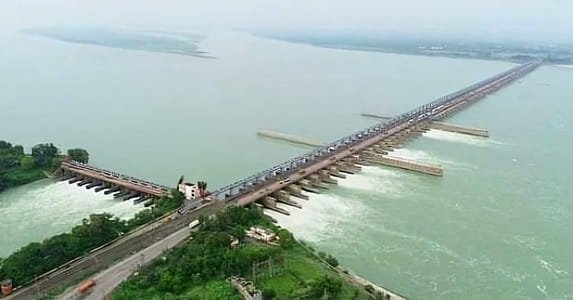
Farakka Bridge is a major new road bridge built across the Ganga River near Farakka in West Bengal, designed to provide a modern alternative to the ageing road crossing over the Farakka Barrage. Developed on the Farakka–Raiganj section of National Highway 12 (NH-12), the four-lane bridge is one of the most important recent highway projects connecting South Bengal with Malda, North Bengal and routes leading towards India’s northeastern states.
The complete project, including the main river bridge and approach roads, stretches for approximately 5.468 km. The bridge has been developed downstream of the existing Farakka Barrage, where road traffic has traditionally shared a narrow and heavily congested transport corridor. The new crossing is intended to separate modern highway traffic from the older barrage infrastructure and significantly improve journey reliability through Farakka.
The bridge should not be confused with the Farakka Barrage itself. The barrage is an older water-control structure that also carries rail and road infrastructure. The new Farakka Bridge is a dedicated four-lane highway bridge constructed specifically to improve road connectivity across the Ganga.
Quick Overview of Farakka Bridge
| Particular | Details |
| Name | Farakka Bridge / New Farakka Bridge |
| Location | Farakka, West Bengal |
| River | Ganga River |
| Highway | NH-12 |
| Road Section | Farakka–Raiganj |
| Project Length | 5.468 km including approaches |
| Configuration | Four-lane road bridge |
| Structure | Twin two-lane bridge structures |
| Approximate Width | 12.5 metres for each bridge structure |
| Nearby Districts | Murshidabad and Malda |
| Nearby Areas | Farakka, Farakka Barrage Township, Kaliachak region and Malda side |
| Main Direction South | Farakka, Jangipur, Berhampore and Kolkata side |
| Main Direction North | Malda, Raiganj, Dalkhola and North Bengal |
| Project Cost | About ₹622.04 crore |
| Known For | Major new Ganga crossing linking North and South Bengal |
The central government’s February 2026 update placed the project at 96% physical completion and described it as nearing completion.
Where is Farakka Bridge Located?
Farakka Bridge crosses the Ganga close to Farakka in Murshidabad district, with the northern approach extending towards the Malda side of the river. The structure has been constructed downstream of the famous Farakka Barrage.
Its location is strategically important because the Ganga forms a major geographical divide between South Bengal and Malda/North Bengal. NH-12 traffic travelling north from Kolkata, Berhampore and Jangipur towards Malda, Raiganj and Dalkhola has to cross the river in the Farakka region.
The older road route across the barrage became increasingly unsuitable for present traffic volumes. The new bridge provides a purpose-built highway crossing rather than depending on infrastructure primarily developed as part of a barrage project.
Farakka itself is located in Murshidabad district, while the wider project extends into Malda district.
Farakka Bridge Route and Road Connectivity
Farakka Bridge forms part of NH-12, one of West Bengal’s most important north-south road corridors.
The highway provides a continuous route between southern West Bengal and the northern districts.
Important connections include:
- Farakka: The principal town and highway reference point on the southern side of the river.
- Malda: One of the most important cities north of the bridge and a major destination for traffic crossing Farakka.
- Raiganj: Located further north along NH-12.
- Dalkhola: Important highway junction providing onward connectivity towards North Bengal.
- Jangipur: Major Murshidabad town south of Farakka.
- Berhampore: Important district and commercial centre further south.
- Kolkata: Connected through the wider NH-12 corridor towards southern West Bengal.
- North Bengal: The bridge strengthens road access towards Siliguri and other northern destinations through connecting national highways.
The wider Farakka–Raiganj section of NH-12 has been developed as a four-lane corridor, helping create a higher-capacity route north of the Ganga crossing. The 100-km Farakka–Raiganj four-laning project was inaugurated in March 2024.
Why is Farakka Bridge Important?
Farakka is one of the most important transport gateways in West Bengal.
For decades, road vehicles crossed the Ganga through infrastructure associated with the Farakka Barrage. That crossing had to accommodate increasing numbers of cars, buses, trucks and other commercial vehicles despite having been created under very different traffic conditions.
The problem became particularly serious because there are few convenient alternative Ganga crossings for through traffic using this north-south route.
The new Farakka Bridge has therefore been developed to provide:
- Higher road capacity
- Four-lane highway movement
- Better separation of road traffic from barrage operations
- Faster movement between Malda and Murshidabad
- Improved freight movement
- More reliable travel towards North Bengal
- Reduced pressure on the ageing barrage crossing
The Ministry of Road Transport and Highways has also highlighted the bridge’s importance for movement of agricultural produce and goods between North and South Bengal, as well as aggregates transported from neighbouring Jharkhand.
Traffic Conditions Around Farakka Bridge
Traffic congestion has historically been one of the biggest problems at Farakka.
The older barrage crossing created a bottleneck for vehicles moving between North and South Bengal. The Ministry of Road Transport and Highways reported in February 2026 that regular commuters using the corridor could lose one to two hours in congestion while crossing the Farakka area.
Heavy commercial traffic makes the situation more difficult. NH-12 carries trucks transporting agricultural products, construction material and other goods alongside buses, cars and local vehicles.
Traffic pressure generally becomes more noticeable during:
- Major holiday and festival travel
- Peak commercial-vehicle movement
- Maintenance restrictions
- Monsoon conditions
- Vehicle breakdowns
- Heavy tourism movement towards North Bengal
The new four-lane bridge has specifically been designed to remove this long-standing capacity constraint.
New Farakka Bridge vs Farakka Barrage
Understanding the difference between these two structures is important.
Farakka Barrage
Farakka Barrage is primarily a water-management structure across the Ganga. The project was constructed to divert water through a feeder canal towards the Bhagirathi-Hooghly system and support conditions in the Kolkata Port approach.
The barrage is approximately 2.2–2.3 km long and has historically carried rail and road connectivity across the river.
New Farakka Bridge
The new Farakka Bridge is a dedicated highway bridge located downstream of the barrage.
Its complete project length is approximately 5.468 km, including approaches, and it provides four traffic lanes. It was developed specifically to handle modern highway traffic using the Farakka–Raiganj corridor.
The two structures therefore serve different primary purposes even though both provide connectivity across the same broad Ganga corridor.
Design and Construction of New Farakka Bridge
The new Farakka Bridge consists of two parallel two-lane structures, creating a four-lane highway crossing.
Each bridge structure is approximately 12.5 metres wide, while the complete project includes approach roads and associated highway infrastructure on both sides of the river.
NHAI identifies the project as the construction of a bridge over the Ganga downstream of Farakka Barrage, including approaches connecting the Farakka–Raiganj highway section.
The project represents an important change from the older barrage crossing. Instead of forcing all major road traffic through a restricted legacy structure, vehicles will have a modern bridge built specifically for highway loads and present-day traffic requirements.
The estimated cost reported by the Ministry of Road Transport and Highways is approximately ₹622.04 crore.
Current Status of Farakka Bridge
The new Farakka Bridge has experienced delays compared with earlier projected opening schedules.
The latest detailed central-government update dated February 28, 2026 recorded approximately 96% physical progress and said the bridge was nearing completion.
In May 2026, however, business organisations in Malda were still asking authorities to open the completed bridge to relieve congestion, indicating that full formal operation had not begun at that stage.
Later local and user-generated reports have referred to limited or temporary vehicle movement on parts of the new crossing, but a clear subsequent central-government announcement confirming full formal commissioning was not present in the authoritative sources reviewed for this article.
Travellers using the route should therefore follow current NHAI or local traffic directions regarding which carriageways are operational.
Role of Farakka Bridge in North-South Bengal Connectivity
The importance of Farakka extends far beyond the surrounding towns.
For road travellers, Farakka functions as a gateway between South Bengal and North Bengal. Traffic travelling from Kolkata and central Bengal towards Malda, North Dinajpur and onward northern destinations converges on this corridor.
The new bridge is expected to make this movement considerably more reliable.
It is particularly important for freight because delays at Farakka affect long-distance trucks transporting food products, industrial supplies and construction materials.
Improved crossing capacity also benefits tourism. Road journeys from Kolkata and other southern districts towards destinations in North Bengal—including routes leading towards Darjeeling, Kalimpong, Dooars and Sikkim—depend on efficient northbound highway connections.
Rail Connectivity at Farakka
An unusual feature of Farakka is that road and railway connectivity across the Ganga have historically been closely associated with the barrage.
The original rail-cum-road crossing on Farakka Barrage helped directly connect railway lines towards Malda and North Bengal. New Farakka Junction, south of the river, is an important station on routes connecting eastern India with Malda and New Jalpaiguri.
The new Farakka Bridge, however, is a road project. It should not be confused with the railway crossing.
This distinction is useful for travellers because searches for “Farakka Bridge” can produce information relating to the barrage, the railway crossing and the new four-lane road bridge.
Major Landmarks Near Farakka Bridge
Several important landmarks and infrastructure facilities are located in the wider Farakka region:
- Farakka Barrage: The best-known infrastructure landmark in the area.
- New Farakka Junction Railway Station: Important railway station south of the Ganga crossing.
- Farakka Barrage Township: Established township associated with the barrage project.
- NTPC Farakka Super Thermal Power Station: Major power-generation facility in the Farakka region.
- Farakka Feeder Canal: Major canal linked with the operation of the barrage.
- Ganga River: The major river crossed by both the barrage and the new highway bridge.
The combination of transport, water-management and power infrastructure makes Farakka one of West Bengal’s most significant infrastructure zones.
Nearby Areas to Farakka Bridge
- Farakka: The main town associated with the bridge and barrage complex.
- Farakka Barrage Township: Residential and administrative township developed around the barrage project.
- New Farakka: Important railway locality centred around New Farakka Junction.
- Kaliachak: Major populated area on the Malda side of the wider highway corridor.
- Malda: Major city north of Farakka and one of the principal destinations for bridge traffic.
- Jangipur: Important town south of Farakka in Murshidabad district.
FAQs About Farakka Bridge
Q1. Is Farakka Bridge the same as Farakka Barrage?
No. The Farakka Barrage is an older water-control structure that also carries transport infrastructure. The New Farakka Bridge is a separate four-lane road bridge constructed downstream of the barrage to carry NH-12 traffic.
Q2. Can trains use the new Farakka Bridge?
No. The new bridge is a road bridge. Railway traffic uses separate railway infrastructure associated with the Farakka crossing.
Q3. Is there a toll on the new Farakka Bridge?
The bridge forms part of the national highway network. Tolling for a journey depends on the applicable NH-12 toll-plaza arrangement rather than a simple bridge-entry charge. Motorists should follow the current NHAI toll notification for their complete route.
Q4. Why was a second Ganga crossing required at Farakka?
The ageing barrage route had become a major traffic bottleneck and was no longer ideal for the volume of modern highway traffic. The new bridge provides a wider four-lane road crossing and is intended to reduce congestion while protecting the older barrage from unnecessary highway load.
Q5. Does Farakka Bridge help travellers going to North Bengal?
Yes. It lies on one of the principal north-south highway routes through West Bengal. The bridge improves the Ganga crossing for traffic travelling towards Malda, Raiganj and onward routes serving North Bengal.