Anji Khad Bridge is one of India’s most remarkable railway engineering projects and a crucial part of the Udhampur-Srinagar-Baramulla Rail Link (USBRL) in Jammu and Kashmir. Located in Reasi district between the Katra and Reasi sections of the railway line, it crosses the deep Anji River valley, a tributary system of the Chenab River.
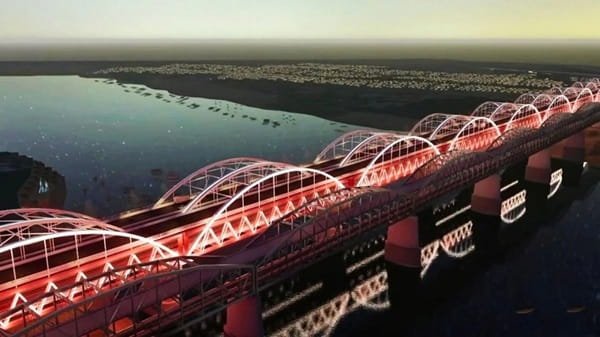
The bridge has a special place in Indian infrastructure because it is India’s first cable-stayed railway bridge. Instead of using a conventional arch or multiple large piers across the gorge, the railway deck is supported by 96 high-tensile stay cables connected to a single inverted-Y-shaped pylon. The structure was inaugurated on 6 June 2025, when the completed USBRL corridor was dedicated to the nation.
Anji Khad Bridge now forms part of the operational rail connection between Jammu, Katra and the Kashmir Valley. With regular Jammu Tawi-Srinagar Vande Bharat services using the USBRL corridor, the bridge has moved from being an engineering project to becoming part of everyday railway connectivity.

Quick Overview of Anji Khad Bridge
| Particular | Details |
| Name | Anji Khad Bridge |
| Location | Reasi district, Jammu and Kashmir |
| Bridge Type | Cable-stayed railway bridge |
| Crosses | Anji River valley |
| Railway Project | Udhampur-Srinagar-Baramulla Rail Link |
| Rail Section | Katra-Reasi/Banihal direction |
| Overall Project Length | Around 725 metres |
| Main Cable-Stayed Bridge | 473.25 metres |
| Ancillary Viaduct | 120 metres |
| Height Above River Valley | About 331 metres |
| Main Pylon Height | 193 metres from foundation |
| Number of Stay Cables | 96 |
| Total Cable Strand Length | About 653 km |
| Inaugurated | 6 June 2025 |
| Built By | Konkan Railway-led project execution |
| Known For | India’s first cable-stayed railway bridge |
Official sources use different length figures because they describe different components. PIB gives the broader structure as about 725 metres, while Konkan Railway lists the main cable-stayed bridge at 473.25 metres plus a 120-metre ancillary viaduct.
Where is Anji Khad Bridge Located?
Anji Khad Bridge is located in the rugged Himalayan terrain of Reasi district in Jammu and Kashmir, roughly 80 km from Jammu city. It lies on the railway alignment between Shri Mata Vaishno Devi Katra and Reasi and forms part of the larger Katra-Banihal section of USBRL.
The bridge crosses the deep Anji River valley south of the Chenab Bridge. The surrounding landscape consists of steep mountain slopes, narrow valleys and geologically challenging terrain that made railway construction particularly difficult.
Its position is strategically important because this was one of the missing links needed to create continuous railway connectivity between Jammu and the Kashmir Valley.
Unlike bridges inside cities, Anji Khad Bridge is not surrounded by dense development. It forms part of a mountain railway corridor consisting of tunnels, viaducts, bridges and short open sections.
Anji Khad Bridge Route and Rail Connectivity
Anji Khad Bridge forms part of the 272-km USBRL project, which connects Udhampur with Srinagar and Baramulla through some of the most difficult railway terrain in India. The complete project includes 36 tunnels covering around 119 km and 943 bridges.
For a train travelling north towards the Kashmir Valley, the broad route is:
Jammu Tawi → Udhampur → Shri Mata Vaishno Devi Katra → Anji Khad Bridge → Reasi → Chenab Bridge corridor → Sangaldan → Banihal → Kashmir Valley
Important railway connections associated with the corridor include:
- Jammu Tawi: Major railway gateway for Jammu and Kashmir.
- Shri Mata Vaishno Devi Katra: Important pilgrimage railway station immediately before the Anji-Reasi section when approaching from Jammu.
- Reasi: District centre and railway stop beyond the Katra side.
- Chenab Rail Bridge: Another major USBRL engineering landmark farther along the mountain section.
- Banihal: Important rail gateway before entering the Kashmir Valley.
- Srinagar: Principal destination served by the new through railway connectivity.
- Budgam: Important railway location in the Kashmir Valley.
The completed USBRL has created an all-weather rail connection between the Kashmir Valley and the broader Indian Railways network.
Why is Anji Khad Bridge Important?
Anji Khad Bridge solved one of the most difficult engineering problems on the USBRL alignment.
The Anji valley is extremely deep, with steep and geologically unstable slopes. Building conventional railway supports across the middle of such terrain would have been difficult. The cable-stayed solution allowed engineers to carry the railway deck across the gorge using a large pylon and stay cables.
Its broader importance includes:
- Completing a difficult section of the Jammu-Kashmir railway corridor
- Supporting year-round passenger connectivity
- Reducing dependence on road travel through difficult mountain terrain
- Improving movement of goods into and out of the Kashmir Valley
- Supporting pilgrimage travel to Katra
- Strengthening tourism and regional economic connectivity
By April 2026, the Railway Ministry reported that the completed railway corridor was already supporting substantial freight movement, including apples from Kashmir as well as inward movement of cement and essential commodities.
Rail Traffic on Anji Khad Bridge
Because Anji Khad Bridge is a railway bridge, its traffic consists of trains rather than cars, buses or two-wheelers.
Passenger operations expanded significantly after the completion of USBRL. The Katra-Srinagar Vande Bharat service began in June 2025, and in 2026 the service was extended through to Jammu Tawi.
Regular Jammu Tawi-Srinagar Vande Bharat services commenced from 2 May 2026. Two pairs operate across the corridor on most days of the week. One service includes stops at Jammu Tawi, Katra, Reasi, Banihal and Srinagar, while the second offers another daily-time option between Jammu and Srinagar.
The railway corridor is also being developed for greater passenger and freight use. By August 2026, Indian Railways said that USBRL was providing all-weather connectivity and that additional train services were being planned or introduced to strengthen the network.
There is therefore no conventional road congestion at Anji Khad Bridge. Train movement is controlled as part of scheduled railway operations.
Engineering and Cable-Stayed Design
The engineering design is the most distinctive aspect of Anji Khad Bridge.
The principal cable-stayed section measures 473.25 metres, while an ancillary viaduct adds another 120 metres. The structure uses a single inverted-Y-shaped pylon measuring approximately 193 metres from the top of its foundation.
A total of 96 high-tensile stay cables support the railway deck. Individual cables range from roughly 82 metres to 295 metres in length, while the total strand material used amounts to approximately 653 km.
Other important features include:
- Asymmetrical cable-stayed configuration
- Single central pylon
- 96 stay cables
- Steel railway superstructure
- Design suited to seismic conditions
- Resistance to strong mountain winds
- Electrified railway infrastructure
- Structural monitoring provisions
More than 8,200 metric tonnes of structural steel were used in the bridge. Its design had to account for earthquakes, high winds and difficult Himalayan geology.
The bridge’s cable-supported arrangement is particularly suited to this location because it reduces the need for numerous tall supports inside the deepest part of the gorge.
Why Anji Khad Bridge Uses One Pylon
One of the most unusual visual features of Anji Khad Bridge is that it does not have two matching towers like many famous cable-stayed road bridges.
Instead, the railway bridge uses one large inverted-Y pylon with cables extending towards the deck on either side.
The asymmetrical layout was selected in response to the difficult terrain and geological conditions around the gorge. Construction access was much more practical from one side, making a single-pylon solution better suited to the site than a conventional symmetrical cable-stayed arrangement. Konkan Railway describes the completed structure as an asymmetrical cable-stayed bridge.
The resulting design has given Anji Bridge a distinctive profile and made it easily recognisable among India’s modern railway bridges.
Anji Khad Bridge and the USBRL Project
Anji Khad Bridge should be viewed as part of a much larger railway achievement rather than as an isolated structure.
The Udhampur-Srinagar-Baramulla Rail Link runs for 272 km through the Himalayas. The entire project was developed to provide dependable railway connectivity to the Kashmir Valley throughout the year.
Among its major engineering works are:
- Anji Khad Cable-Stayed Bridge
- Chenab Rail Bridge
- Numerous major and minor bridges
- Long mountain tunnels
- Electrified track
- Stations in difficult Himalayan terrain
By August 2026, the Railway Ministry described the full project as commissioned and providing all-weather connectivity. It also reported that about 215 km of access roads, including 320 road bridges and a tunnel, had been constructed during the project, providing additional benefits to local communities.
Public Transport and Access Near Anji Khad Bridge
Anji Khad Bridge itself is railway infrastructure rather than a conventional tourist road destination.
The most important nearby passenger railway stations are:
- Shri Mata Vaishno Devi Katra Railway Station
- Reasi Railway Station
- Jammu Tawi Railway Station
Katra is also well connected by buses, taxis and private vehicles from Jammu and surrounding areas. Reasi has road connections with Katra, Jammu and other parts of the district.
For most travellers, the most practical way to experience Anji Khad Bridge is therefore while travelling by train on the USBRL corridor, rather than trying to approach the railway structure itself by road.
Major Landmarks and Attractions Near Anji Khad Bridge
Several important destinations are located in the wider Reasi-Katra region:
- Shri Mata Vaishno Devi Shrine: One of India’s major pilgrimage destinations, reached from Katra.
- Katra: Main pilgrimage and tourism base near the bridge corridor.
- Reasi: District headquarters and an important railway stop.
- Chenab Rail Bridge: World’s highest railway arch bridge and another landmark of USBRL.
- Salal Dam: Major hydroelectric and reservoir project in Reasi district.
- Shiv Khori: Important cave shrine in the wider Reasi region.
The combination of pilgrimage tourism and major railway infrastructure has significantly increased the transport importance of the Reasi-Katra belt.
Nearby Areas to Anji Khad Bridge
- Reasi: District headquarters and one of the most important nearby railway locations.
- Katra: Major pilgrimage town and railway hub south of the bridge.
- Jammu: Principal large city and railway gateway for the region.
- Sangaldan: Important railway location farther along the USBRL mountain section.
- Banihal: Key railway town on the route towards the Kashmir Valley.
FAQs About Anji Khad Bridge
Q1. Can tourists walk across Anji Khad Bridge?
No. Anji Khad Bridge is active Indian Railways infrastructure and is not a public pedestrian sightseeing bridge. Visitors should not enter railway tracks or restricted railway property.
Q2. Will a Delhi-to-Katra train cross Anji Khad Bridge?
No. A train terminating at Shri Mata Vaishno Devi Katra does not need to cross Anji Khad Bridge. The bridge lies farther along the railway route towards Reasi and the Kashmir Valley. Trains continuing beyond Katra towards Srinagar use this section.
Q3. Is there a separate ticket for travelling over Anji Khad Bridge?
No. Passengers simply purchase the normal railway ticket for a train using the USBRL route. There is no separate bridge-crossing ticket.
Q4. Does Anji Khad Bridge carry road vehicles?
No. It is exclusively a railway bridge. Cars, buses and motorcycles do not use the bridge deck.
Q5. Can travellers visit Anji Khad Bridge and Chenab Bridge as ordinary roadside tourist attractions?
Both are operational railway structures in difficult mountain terrain, so public access is controlled. Travellers should not assume that the railway decks are open for sightseeing or walking. The safest way to experience the structures is through authorised rail travel or permitted viewpoints and local roads outside restricted railway property.