When you need money to manage unexpected expenses, pay medical bills, renovate your home, or cover other personal costs, borrowing can help bridge the financial gap. Two common financing options are a personal line of credit and a bank personal loan. Both allow eligible borrowers to access funds without typically pledging collateral, but they work differently.
A personal line of credit offers flexible access to funds up to an approved limit, while a personal loan provides a fixed amount that is generally repaid through scheduled monthly instalments. Understanding their differences can help you choose the option that matches your financial needs, spending habits, and repayment capacity.
What Is a Personal Line of Credit?
A personal line of credit is a revolving credit facility that allows a borrower to access money up to a predetermined limit. Instead of receiving the entire approved amount upfront, the borrower can withdraw funds when needed, subject to the lender’s terms.
Interest is generally charged on the amount used rather than the full credit limit, although fees and other charges may apply. As the borrower repays the outstanding balance, the available credit may become available again during the facility’s validity period.
For example, suppose a lender approves a personal line of credit of ₹2 lakh. If you withdraw ₹50,000 for an emergency, you may continue to access the remaining available limit, subject to the agreement. You generally do not pay interest on the unused portion, but this depends on the product’s fee structure.
A personal line of credit can be useful when expenses arise at different times and the exact amount required is uncertain.
What Is a Bank Personal Loan?
A bank personal loan is a financing arrangement in which a bank lends a fixed amount to an eligible borrower. The borrower receives the approved funds, usually as a lump sum, and repays the loan through instalments over an agreed period.
Personal loans are generally unsecured, meaning the borrower does not need to pledge assets such as property or gold. However, the bank assesses the applicant’s income, credit history, employment status, existing debts, and repayment capacity before approving the application.
For example, if a bank approves a personal loan of ₹2 lakh for medical expenses, the borrower receives the amount and begins repaying it according to the agreed schedule. Interest is calculated under the loan’s terms, and the monthly EMI typically includes principal and interest.
A personal loan may be appropriate when you know exactly how much money you need for a specific expense.
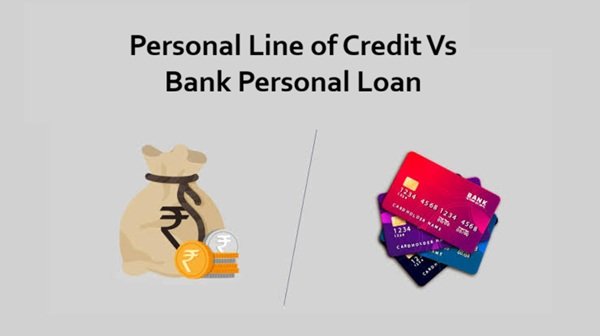
Personal Line of Credit Vs Bank Personal Loan: Key Differences
| Feature | Personal line of credit | Bank personal loan |
| Fund access | Withdraw as needed within the approved limit | Usually received as a lump sum |
| Credit structure | Revolving facility | Fixed-term loan |
| Interest calculation | Generally based on the amount used | Based on the outstanding loan under the agreed terms |
| Repayment | May offer flexible repayment arrangements | Usually repaid through fixed scheduled EMIs |
| Repeated borrowing | Available credit may replenish after repayment | A new application may be needed for additional funds |
| Best suited for | Uncertain or recurring expenses | A defined, one-time expense |
| Cost predictability | Can vary with usage and interest rates | Often easier to forecast with a fixed rate and EMI |
| Main risk | Repeated borrowing can keep balances outstanding | Long repayment commitments and total interest costs |
Actual features depend on the lender and the specific credit product.
1. Interest Rates and Borrowing Costs
The cost of borrowing is an important factor when comparing these options. A personal line of credit may charge interest only on the amount withdrawn, making it useful when you need occasional access to money rather than the entire approved limit.
However, some facilities include annual fees, maintenance charges, withdrawal fees, or other costs. Interest rates may also be variable, depending on the product. These factors can make the facility more expensive than expected if you borrow repeatedly or keep a balance outstanding.
Bank personal loans may offer fixed interest rates, although variable-rate arrangements can exist depending on the product. A fixed-rate loan can make repayment easier to plan because the EMI and repayment schedule are generally established at the outset.
When comparing offers, review the annual percentage rate (APR), where disclosed, processing fees, applicable taxes, late-payment charges, and total repayment amount. Do not assume that a line of credit is cheaper simply because interest is charged only on the amount used.
2. Flexibility and Access to Funds
A personal line of credit offers greater flexibility when the timing or size of your expenses is uncertain. You can draw funds when required rather than borrowing the full amount at once. This can be useful for managing irregular medical expenses, emergency repairs, or several smaller payments over time.
A personal loan is generally more suitable for expenses with a known cost, such as a planned wedding, a major purchase, or a home renovation with a defined budget. Receiving the entire amount upfront can simplify payment arrangements.
The important distinction is that a line of credit provides access to funds over time, while a personal loan provides a specific amount for a defined borrowing purpose. Flexibility can be helpful, but it can also encourage unnecessary borrowing if the available limit is treated as extra income.
3. Eligibility and Approval Process
Both options usually require an assessment of creditworthiness and repayment capacity. Banks may review income, employment stability, credit history, existing EMIs, and bank statements before approving either facility.
Eligibility criteria for a personal line of credit vary by lender. Some facilities may be available to existing customers, while others require a separate application and credit assessment. The approved limit depends on the lender’s policies and the applicant’s financial profile.
Personal loan eligibility also varies, but the bank typically evaluates the requested loan amount and the borrower’s ability to repay it over the selected tenure.
A pre-approved offer does not always mean that funds are guaranteed. Review the final terms, charges, and approval conditions before accepting either product.
4. Repayment and Financial Planning
Personal loans generally provide a clear repayment schedule with monthly EMIs. This makes it easier to include repayments in a monthly budget and estimate when the debt will be fully repaid.
A personal line of credit may provide more flexible repayment arrangements, but the borrower must understand minimum payment requirements, interest charges, and any deadline for repaying the outstanding balance. Making only minimum payments can extend repayment and increase the overall cost.
For example, someone who borrows repeatedly from a credit line without paying down the principal may remain in debt for much longer than expected. By contrast, a personal loan with a defined tenure provides a clearer repayment endpoint, provided payments are made as agreed.
Choose a repayment structure that suits your income and spending habits, and avoid borrowing more than you can comfortably repay.
Which Option Is Better for You?
A personal line of credit may be better if you need flexible access to funds for expenses that arise at different times. It can be particularly useful when you want to borrow smaller amounts rather than receive a large lump sum.
A bank personal loan may be preferable when you have a specific expense, know the amount required, and want a structured repayment plan. A fixed-rate personal loan can also provide greater certainty about the cost of borrowing.
Before deciding, compare offers from reputable lenders and examine the interest rate, fees, repayment rules, and consequences of missed payments. Also consider whether savings or a payment arrangement could meet your needs without borrowing.
Conclusion
A personal line of credit and a bank personal loan offer different ways to manage personal financial needs. A line of credit provides flexible, potentially reusable access to funds, while a personal loan offers a fixed amount with a structured repayment schedule.
Neither option is automatically better for every borrower. The right choice depends on the timing of your expenses, the total borrowing cost, your preference for repayment flexibility, and your ability to manage debt responsibly. Compare the actual terms carefully and choose the option that meets your needs without placing unnecessary pressure on your future finances.