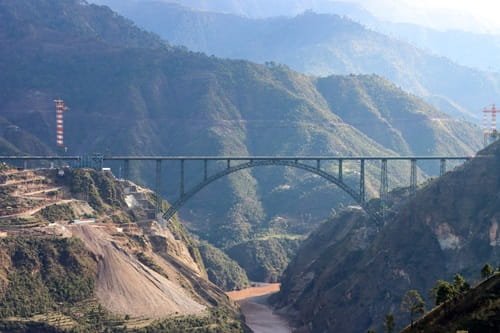
Chenab Bridge is one of India’s most remarkable railway engineering achievements and the world’s highest railway arch bridge. Built across the Chenab River in Reasi district of Jammu and Kashmir, the bridge rises 359 metres above the riverbed and has a total length of 1,315 metres. Its railway deck stands around 35 metres higher than the Eiffel Tower, making the structure exceptional even by global engineering standards.
The bridge forms an important part of the Udhampur-Srinagar-Baramulla Rail Link (USBRL), which provides continuous railway connectivity between the Kashmir Valley and the rest of India’s railway network. Chenab Bridge was formally inaugurated on June 6, 2025, when passenger railway connectivity through this difficult Himalayan section entered a new phase.
Unlike a normal urban bridge that primarily handles road traffic, Chenab Bridge is important because of its railway function, extraordinary height, challenging construction environment and role in improving year-round transportation between Jammu and the Kashmir Valley.
Quick Overview of Chenab Bridge
| Particular | Details |
| Name | Chenab Rail Bridge |
| Location | Reasi district, Jammu and Kashmir |
| River | Chenab River |
| Bridge Type | Steel railway arch bridge |
| Total Length | 1,315 metres |
| Height Above Riverbed | 359 metres |
| Main Arch Span | 467 metres |
| Number of Spans | 17 |
| Railway Project | Udhampur-Srinagar-Baramulla Rail Link |
| Railway Section | Katra-Banihal section |
| Nearby Places | Kauri, Bakkal, Salal, Reasi and Katra |
| Used For | Railway traffic |
| Inaugurated | June 6, 2025 |
| Known For | World’s highest railway arch bridge |
Where is Chenab Bridge Located?
Chenab Bridge is located across the Chenab River in Reasi district of Jammu and Kashmir. It lies along the mountainous railway alignment connecting the Jammu region with the Kashmir Valley.
The bridge spans the deep gorge between the Bakkal and Kauri areas. The surrounding terrain consists of steep Himalayan slopes, deep valleys and difficult geological conditions. This remote location was one of the biggest challenges faced during construction.
Reasi is the nearest major district town, while Shri Mata Vaishno Devi Katra is an important railway and tourism centre to the south.
The setting is very different from bridges located in large cities. There are no major urban neighbourhoods immediately around the structure. Instead, the bridge is surrounded by mountains, railway tunnels, valleys and other infrastructure developed as part of the USBRL project.
Chenab Bridge Railway Route and Connectivity
Chenab Bridge forms part of the 272-km Udhampur-Srinagar-Baramulla Rail Link, one of India’s most difficult railway infrastructure projects.
The USBRL was developed to establish direct railway connectivity through the challenging Himalayan terrain of Jammu and Kashmir. The route includes a large number of tunnels, bridges and specially engineered structures.
Important destinations connected through the wider railway corridor include:
- Shri Mata Vaishno Devi Katra: An important railway station and pilgrimage gateway located south of the bridge.
- Reasi: District headquarters and an important town in the wider Chenab Bridge region.
- Sangaldan: An important railway point on the mountainous section of the USBRL.
- Banihal: A major railway gateway between the Jammu region and Kashmir Valley.
- Srinagar: The largest city in Kashmir and one of the principal destinations served by the railway corridor.
- Baramulla: Located further north and connected through the Kashmir Valley railway network.
The bridge therefore acts as a vital component of a much larger railway system rather than functioning as an isolated landmark.
Why is Chenab Bridge Important?
Chenab Bridge is important because it solved one of the most difficult geographical challenges faced while building the railway line to Kashmir.
The Chenab River flows through a very deep gorge surrounded by steep mountain slopes. Railway lines cannot easily descend into such valleys and climb back because trains require controlled gradients. Engineers therefore needed to carry the railway across the gorge at a very high elevation.
The bridge also contributes to the broader objective of providing all-weather railway connectivity to the Kashmir Valley. Road travel between Jammu and Kashmir can sometimes be affected by landslides, snowfall, congestion and difficult mountain conditions.
The completion of the railway corridor therefore provides another major transport option for passengers and goods travelling through the region.
Chenab Bridge has also become a symbol of India’s ability to build large infrastructure projects in extremely difficult terrain.
Engineering Design of Chenab Bridge
The engineering design is what makes Chenab Bridge particularly distinctive.
The structure uses a massive steel arch stretching across the gorge. Its main arch span measures approximately 467 metres, while the entire bridge extends for 1,315 metres.
Around 29,000 tonnes of structural steel were used during construction.
The arch carries the railway deck high above the Chenab River while transferring structural loads into large foundations built into the mountain slopes on both sides.
Constructing the bridge also required specialised equipment. Because the valley was too deep for conventional construction methods, engineers developed a cable-crane system stretching between both sides of the gorge.
Large pylons were erected on the slopes, and cables were used to transport heavy structural components across the valley. This allowed engineers to assemble sections of the bridge at a location where normal ground-based cranes could not operate effectively.
Designed for Extreme Himalayan Conditions
A bridge of this scale has to withstand far more than the normal weight of trains.
Chenab Bridge has been designed considering several demanding conditions, including:
- Strong winds
- Seismic activity
- Extreme temperatures
- Heavy structural loads
- Mountain slope instability
- Fatigue caused by repeated train movements
- Certain blast-related loads
Wind studies were particularly important because the bridge deck is positioned hundreds of metres above the riverbed, where strong winds can affect railway operations.
Special monitoring and structural safety systems have therefore been incorporated into the bridge.
The steel structure was also designed for long-term durability under the climatic conditions of the region.
Building the Bridge on Himalayan Slopes
The spectacular arch attracts most attention, but stabilising the mountain slopes was another major part of the project.
Before the main bridge structure could be completed, engineers had to ensure that the foundations on both sides of the Chenab gorge were secure.
Extensive geological investigations, rock stabilisation and slope-protection work were undertaken. Specialist institutions, including Indian engineering and research organisations, were involved in evaluating the difficult terrain.
Access presented another challenge.
The construction area was remote and initially lacked adequate roads for moving workers, machinery and building materials. Approach roads therefore had to be developed through the mountains before large-scale bridge construction could proceed.
This supporting infrastructure ultimately improved access to several previously difficult-to-reach areas in the wider region.
Chenab Bridge and the USBRL Project
Chenab Bridge is part of the much larger Udhampur-Srinagar-Baramulla Rail Link project.
The 272-km railway passes through some of India’s most difficult railway terrain. Long tunnels and numerous bridges were required because the route repeatedly encounters mountains, rivers and deep valleys.
Another major engineering landmark on the same railway project is the Anji Khad Bridge, India’s first cable-stayed railway bridge.
The two structures are sometimes confused, but they use completely different designs.
Chenab Bridge uses a huge steel arch beneath the railway deck.
Anji Khad Bridge uses cables connected to a tall pylon to support the railway deck.
Together, they demonstrate the range of engineering solutions required to complete railway connectivity through this part of Jammu and Kashmir.
Train Services Across Chenab Bridge
Chenab Bridge is now part of the operational railway network connecting Katra with the Kashmir Valley.
The inauguration of the completed railway section in June 2025 was accompanied by the launch of Vande Bharat Express services between Shri Mata Vaishno Devi Katra and Srinagar.
These services provide passengers with a direct railway option through the mountainous corridor.
Travelling across Chenab Bridge by train gives passengers an opportunity to experience one of the most dramatic railway crossings in India. However, because the bridge is so high and the train passes across it relatively quickly, passengers may not fully appreciate the enormous scale of the arch while sitting inside the train.
The most impressive views of the bridge are generally from surrounding viewpoints where the complete steel arch and the deep river gorge can be seen together.
Chenab Bridge as an Engineering Landmark
Chenab Bridge is more than a transportation structure. It has become an engineering landmark associated with India’s railway development in the Himalayas.
Its 359-metre height has attracted international attention, but the difficult construction conditions make the project equally significant.
Engineers had to deal with deep valleys, unstable slopes, difficult access, strong winds and challenging geological conditions while maintaining the precise alignment required for railway tracks.
The bridge also demonstrates how modern railway engineering can overcome terrain that would once have made continuous railway connectivity extremely difficult.
For engineering students and infrastructure enthusiasts, Chenab Bridge has become an important case study in large-span bridge design, mountain construction and railway infrastructure.
Tourism Around Chenab Bridge
The dramatic appearance of Chenab Bridge has also generated considerable tourism interest.
The massive steel arch rising above the Chenab River, surrounded by mountains, has made it one of the most photographed modern infrastructure landmarks in Jammu and Kashmir.
However, Chenab Bridge is an operational railway structure rather than a public pedestrian bridge. Visitors cannot simply walk onto the railway deck for sightseeing.
Tourists should use authorised viewing areas and public roads in the surrounding region and follow local security and railway restrictions.
Reasi can serve as an important base for exploring attractions in the wider region, while Katra remains the major tourism centre because of Shri Mata Vaishno Devi.
Nearby Places to Chenab Bridge
- Kauri: One of the settlements closest to the railway bridge and closely associated with the bridge alignment.
- Bakkal: Located on the opposite side of the Chenab gorge and associated with the other end of the bridge.
- Reasi: District headquarters and the main urban centre in the wider region.
- Salal: Located along the Chenab River and well known for the Salal Hydroelectric Project.
- Katra: An important pilgrimage and railway town serving visitors travelling to Shri Mata Vaishno Devi.
- Anji Khad Bridge: Another major railway engineering structure on the USBRL and India’s first cable-stayed railway bridge.
FAQs About Chenab Bridge
Q1. Can cars and motorcycles travel on Chenab Bridge?
No. Chenab Bridge is exclusively a railway bridge. Regular cars, motorcycles, buses and other road vehicles cannot cross it.
Q2. Can tourists walk across Chenab Bridge?
The railway deck is not a normal public pedestrian walkway. Since it is part of an operational railway line, entry is controlled and visitors should not attempt to access railway property without official permission.
Q3. Is Chenab Bridge higher than the Eiffel Tower?
Yes. Chenab Bridge stands 359 metres above the riverbed, while the Eiffel Tower is approximately 324 metres high. The comparison relates only to vertical height; the two structures have completely different designs and purposes.
Q4. Is Chenab Bridge the same as Anji Khad Bridge?
No. They are two different railway bridges on the USBRL project. Chenab Bridge is a steel arch bridge, while Anji Khad Bridge is India’s first cable-stayed railway bridge.
Q5. Can Chenab Bridge withstand earthquakes?
The bridge has been designed considering seismic conditions in the Himalayan region. Earthquake forces, strong winds and other extreme structural loads were taken into account during its engineering and safety assessment.
Q6. Are there trains running over Chenab Bridge now?
Yes. Passenger railway services operate over the completed USBRL section, including services connecting Shri Mata Vaishno Devi Katra with Srinagar.
Q7. Is Chenab Bridge open throughout the year?
The bridge itself forms part of an all-weather railway corridor. However, actual train operations can still be affected occasionally by operational, weather-related or maintenance requirements elsewhere along the railway route.