The world’s longest bridges are massive transport structures built to carry railways and highways across rivers, lakes, wetlands, plains and densely developed areas. Unlike famous suspension bridges that are known mainly for their main span, many of the world’s longest bridges are actually continuous viaducts stretching for dozens of kilometres. They help high-speed trains and road traffic move across difficult terrain without frequent ground-level crossings, sharp diversions or interruptions.
China dominates the list because of its extensive high-speed rail network, where long elevated viaducts are used to maintain straight and efficient routes. Taiwan and Japan also have exceptionally long railway viaducts, while countries such as Thailand, the Philippines and the United States appear with major elevated road bridges and causeways.
As of 2026, the Danyang-Kunshan Grand Bridge in China remains the longest bridge in the world, extending for about 164.8 km. The ranking below compares completed and operational bridges by their total structural length, which is why railway viaducts occupy several of the top positions.
1. Danyang-Kunshan Grand Bridge, China – 164.8 km
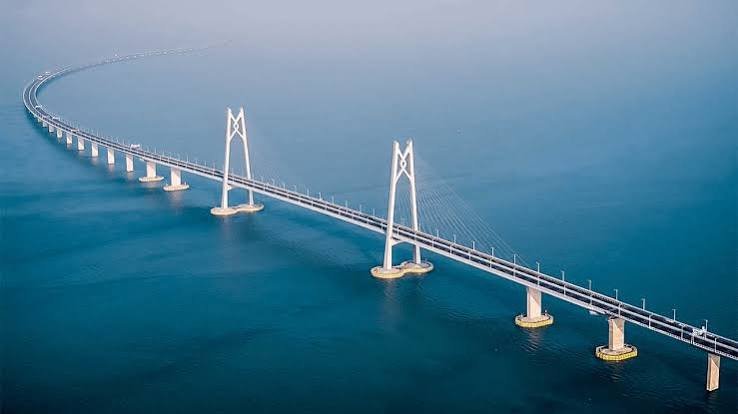
The Danyang-Kunshan Grand Bridge carries the Beijing-Shanghai High-Speed Railway through eastern China. It has held the Guinness record for the world’s longest bridge since 2011.
- Length: About 164.8 km.
- Type: High-speed railway viaduct.
- Location: Jiangsu Province, between Danyang and Kunshan.
- Opened: 2011, after completion in 2010.
- Importance: It crosses the low-lying Yangtze River Delta, including canals, rivers, roads and a long section near Yangcheng Lake, while keeping the rail route direct and elevated.
2. Changhua-Kaohsiung Viaduct, Taiwan – 157.317 km
This vast viaduct carries a major section of Taiwan High Speed Rail through western Taiwan. Its length places it second among the world’s longest bridge structures.
- Length: 157.317 km.
- Type: High-speed railway viaduct.
- Route: From the Changhua area towards Zuoying in Kaohsiung.
- Completed: 2004; high-speed passenger service began in 2007.
- Engineering feature: The viaduct system was designed for a seismically active region and helps the railway cross roads, waterways and developed land with a smooth high-speed alignment.
3. Kita-Yaita Viaduct, Japan – 114.424 km
Kita-Yaita Viaduct forms part of Japan’s Tohoku Shinkansen. It is often missing from popular online lists, but by total viaduct length it ranks among the world’s longest completed bridge structures.
- Length: About 114.424 km.
- Country: Japan.
- Type: High-speed railway viaduct.
- Railway: Tohoku Shinkansen; the relevant route opened in 1982.
- Importance: Its long elevated alignment separates high-speed trains from roads, settlements and changing ground conditions, helping maintain a fast and uninterrupted rail corridor.
4. Tianjin Grand Bridge, China – 113.7 km
Also called the Langfang-Qingxian viaduct, Tianjin Grand Bridge is another enormous structure on the Beijing-Shanghai High-Speed Railway.
- Length: About 113.7 km.
- Type: High-speed railway viaduct.
- Location: Between Langfang and Qingxian in northern China.
- Opened: June 2011.
- Construction: It uses repeated concrete box-girder spans on piers. The elevated design reduced the need for numerous separate crossings and used less land than a wide railway embankment.
5. Cangde Grand Bridge, China – 105.881 km
Cangde Grand Bridge is a long railway viaduct on the Beijing-Shanghai high-speed corridor. It extends through northern China towards the Shandong border.
- Length: About 105.881 km.
- Type: High-speed railway viaduct.
- Completed: 2010.
- Structure: Engineering references describe more than 3,000 piers along the bridge.
- Importance: The design keeps high-speed trains separated from local roads and fields while addressing seismic forces and settlement in softer ground.
6. Weinan Weihe Grand Bridge, China – 79.732 km
The Weinan Weihe Grand Bridge carries the Zhengzhou-Xi’an high-speed route across the Wei River region. It briefly held the world length record after completion.
- Length: 79.732 km.
- Type: High-speed railway viaduct.
- Location: Shaanxi Province, China.
- Completed: 2008; the railway opened in 2010.
- Crossings: It passes over the Wei River twice, several smaller rivers, highways and railway lines, creating a continuous route across a complex transport landscape.
7. Bang Na Expressway, Thailand – 54 km
Bang Na Expressway, officially the Burapha Withi Expressway, is a huge elevated road east of Bangkok. Guinness recognises it as the world’s longest road bridge.
- Length: About 54 km under the Guinness measurement.
- Type: Six-lane elevated expressway.
- Location: Bangkok metropolitan area, Thailand.
- Opened: February 2000.
- Importance: It runs largely above an existing highway, adding road capacity through developed areas without requiring an entirely new surface corridor.
8. Beijing Grand Bridge, China – 48.153 km
Beijing Grand Bridge is another major viaduct on the Beijing-Shanghai High-Speed Railway. It carries the railway out of the Beijing area towards Hebei.
- Length: 48.153 km.
- Type: High-speed railway viaduct.
- Location: Beijing and the route towards Langfang.
- Completed: 2010; opened with the railway in 2011.
- Importance: The long elevated alignment separates high-speed trains from roads and ground-level development and provides a consistent railway route.
9. Metro Manila Skyway System, Philippines – About 39.2 km
The Metro Manila Skyway is a long elevated expressway system serving the Philippine capital. It carries traffic above existing roads through a densely built urban region.
- Length: Approximately 39.2 km for the elevated system commonly used in global rankings.
- Type: Elevated urban expressway.
- Location: Metro Manila, Philippines.
- Development: Built and extended in several stages.
- Importance: It links major north-south expressway approaches and adds road capacity where acquiring a completely new ground-level route would be difficult.
10. Lake Pontchartrain Causeway, United States – 38.422 km
The Lake Pontchartrain Causeway consists of two parallel road bridges across Lake Pontchartrain in Louisiana. It is especially famous for its uninterrupted distance over water.
- Length: 38.422 km for the longer continuous span recognised by Guinness.
- Type: Road causeway and trestle bridge.
- Connects: Metairie with Mandeville, Louisiana.
- Opened: First span in 1956; second parallel span in 1969.
- Record: Guinness recognises it as the world’s longest continuous bridge over water, and it provides a direct route across the lake for the New Orleans region.
How This 2026 Ranking Is Prepared
The term ‘longest bridge’ is used differently by different sources. This list uses total structural length and includes completed railway viaducts, elevated road bridges and causeways. It does not rank projects that are proposed or still under construction. If only bridges continuously over water were counted, Lake Pontchartrain and other sea or lake crossings would rank much higher.
Conclusion
The world’s longest bridges show how modern transport routes can be carried across entire landscapes, not just single rivers. High-speed railway viaducts dominate the 2026 ranking, with Danyang-Kunshan still at the top. Long road structures such as Bang Na Expressway, Metro Manila Skyway and Lake Pontchartrain Causeway show how the same elevated approach can solve very different transport problems.