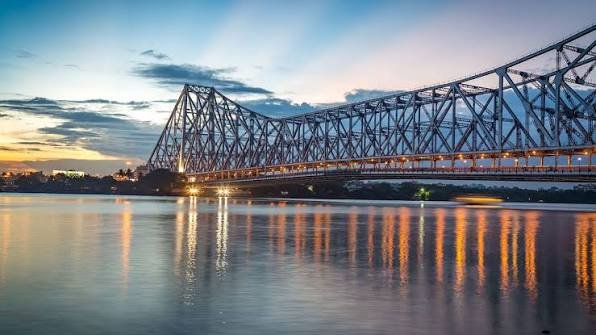
Howrah Bridge is one of Kolkata’s most recognisable landmarks and one of the most important road connections across the Hooghly River. Officially known as Rabindra Setu, the massive steel bridge connects central Kolkata with Howrah and provides direct access to the Howrah railway and transport hub. Despite its official name, Howrah Bridge remains the name almost universally used by residents, commuters and visitors.
Commissioned in 1943, the bridge is remarkable not only for its age but also for its engineering. It is a suspension-type balanced cantilever bridge built largely with riveted steel rather than nuts and bolts. More than eight decades later, it continues to carry an enormous volume of road and pedestrian traffic every day while remaining a defining part of Kolkata’s skyline.
For travellers, Howrah Bridge is also a useful geographical reference point. Burrabazar, BBD Bagh, Strand Road and the northern parts of central Kolkata lie on the Kolkata side, while Howrah Railway Station and the wider Howrah city area are reached on the western side of the river.
Quick Overview of Howrah Bridge
| Particular | Details |
| Name | Howrah Bridge |
| Official Name | Rabindra Setu |
| Location | Kolkata–Howrah, West Bengal |
| River | Hooghly River |
| Bridge Type | Suspension-type balanced cantilever bridge |
| Opened | 1943 |
| Renamed Rabindra Setu | 14 June 1965 |
| Total Length | Around 705 metres |
| Main Span | Around 457.2 metres |
| Width | Around 21.6 metres roadway, with pedestrian paths |
| Connects | Kolkata and Howrah |
| Nearby Railway Station | Howrah Railway Station |
| Nearby Metro | Howrah Metro Station |
| Daily Usage | Around 1 lakh vehicles and about 1.5 lakh pedestrians |
| Maintained By | Syama Prasad Mookerjee Port, Kolkata |
| Known For | Engineering, heritage, heavy traffic and iconic Kolkata views |
The bridge dimensions and engineering classification are recorded by its builder, Braithwaite, Burn & Jessop Construction Company, while recent bridge-health reporting places daily movement at roughly 100,000 vehicles and 150,000 pedestrians.
Where is Howrah Bridge Located?
Howrah Bridge crosses the Hooghly River between Kolkata on the eastern bank and Howrah on the western bank. Its Howrah end lies close to Howrah Railway Station, making it one of the most important gateways for passengers arriving in Kolkata by rail. The Howrah district administration places the railway station within walking distance of the bridge.
On the Kolkata side, the bridge meets the busy Strand Road and Burrabazar area. From here, motorists can proceed towards BBD Bagh, MG Road, Central Avenue and other parts of central and north Kolkata.
The location explains why Howrah Bridge remains so heavily used. It does not simply connect two riverbanks; it links one of eastern India’s biggest railway terminals with Kolkata’s traditional commercial centre.
Howrah Bridge Route and Road Connectivity
Howrah Bridge provides one of the most direct road links between Howrah and central Kolkata. Vehicles crossing from Howrah enter the Kolkata side close to Burrabazar and Strand Road, from where several major urban corridors become accessible.
Important connections from Howrah Bridge include:
- Howrah Railway Station: Immediately accessible on the Howrah side and one of the most important railway terminals in India.
- Burrabazar: Located just beyond the Kolkata end and known as one of the city’s largest wholesale commercial districts.
- Strand Road: Runs along the Kolkata riverfront and provides connections towards BBD Bagh and adjoining areas.
- BBD Bagh: Kolkata’s historic administrative and business district, accessible from the bridge through the central road network.
- MG Road: An important east-west road connection serving central and north Kolkata.
- Central Avenue: Provides onward access towards several important parts of north and central Kolkata.
For motorists moving between Howrah and Kolkata, alternatives across the Hooghly include Vidyasagar Setu farther south and Vivekananda Setu/Nivedita Setu farther north. However, Howrah Bridge remains particularly important for traffic associated with Howrah Station, Burrabazar and central Kolkata.
Why is Howrah Bridge Important?
Howrah Bridge performs several roles at the same time.
First, it is a major urban transport link. Approximately 100,000 vehicles and around 150,000 pedestrians use the bridge daily, illustrating how deeply it remains integrated into Kolkata’s transport network.
Second, it provides a critical connection to Howrah Railway Station. Passengers arriving from different parts of West Bengal and India use the bridge to reach central Kolkata by road.
Third, the Kolkata end opens almost directly into Burrabazar, one of the city’s most important wholesale trading zones. Goods movement, buses, taxis, private vehicles and pedestrians therefore converge on the same corridor.
Finally, Howrah Bridge has significance far beyond transportation. The Government of India’s tourism portal describes it as one of the defining symbols of Kolkata, while its steel silhouette has become closely associated with the city in photography, films, art and popular culture.
Traffic Conditions at Howrah Bridge
Traffic around Howrah Bridge can become very heavy, particularly during weekday office hours and periods of high passenger movement at Howrah Station. The Burrabazar approach is especially busy because commercial traffic, buses, taxis, private vehicles and pedestrians all use the surrounding road network.
The bridge itself carries about one lakh vehicles each day, so delays around its approaches can quickly affect surrounding roads.
Traffic conditions may also be influenced by restrictions or maintenance work on other Hooghly crossings. When another major river bridge faces traffic controls, Howrah Bridge and its approach roads can become an important alternative corridor.
Anyone travelling to Howrah Railway Station during peak periods should therefore keep sufficient additional time rather than calculating the journey only by distance.
Engineering and Historical Significance of Howrah Bridge
This is where Howrah Bridge differs from an ordinary city bridge.
The present structure replaced an earlier pontoon bridge that had connected Howrah and Calcutta. Growing traffic eventually created the need for a permanent and substantially stronger crossing. The new bridge was designed by Rendel, Palmer & Tritton, while fabrication and erection were carried out by Braithwaite, Burn & Jessop Construction Company Limited (BBJ).
Construction took place during the difficult years surrounding World War II. Around 26,000 tonnes of steel were required, and when much of the expected imported steel became unavailable because of the war, Tata Steel supplied about 23,000 tonnes of high-tensile steel for the project.
The structure was built using riveted construction rather than conventional nuts and bolts. Its bridge deck is suspended from the main trusses through 39 pairs of hangers. The total length is approximately 705 metres, while its principal span is about 457.2 metres. At the time it was commissioned, it ranked among the world’s longest cantilever bridges.
The bridge opened to the public in 1943 without a large formal opening ceremony during the wartime period. In 1965, it was officially renamed Rabindra Setu in honour of Nobel laureate Rabindranath Tagore.
Maintenance, Structural Monitoring and Modern Upgrades
Keeping an eight-decade-old bridge operating under modern traffic loads requires continuing inspection and maintenance.
Syama Prasad Mookerjee Port, Kolkata, the bridge’s custodian, commissioned a major health assessment involving RITES and specialists from Rendel. The assessment found no major signs of structural weakness, although replacement of the deck surface and work on certain joints were recommended. Authorities also proposed installing sensors and digital monitoring equipment capable of tracking structural stresses in real time.
Howrah Bridge has also received a major visual upgrade. A new dynamic illumination system began operating in August 2026, adding profile, volumetric and skeleton lighting. Plans also include synchronised music and sound programmes on selected occasions such as festivals and national celebrations.
The lighting upgrade gives the bridge an additional role as a night-time heritage attraction while allowing the structural form of the steel trusses to remain the centrepiece.
Public Transport Near Howrah Bridge
Howrah Bridge is surrounded by one of Kolkata’s strongest public-transport networks.
Howrah Railway Station is the most important transport facility near the western end. Local suburban trains as well as long-distance services connect Howrah with numerous destinations.
Metro connectivity has improved significantly. Howrah Metro Station is part of Kolkata Metro’s East-West corridor, with the official KMRCL station sequence connecting Howrah towards Mahakaran, Esplanade, Sealdah and the Salt Lake side.
Other transport options include:
- City and suburban buses
- Yellow taxis
- App-based cabs
- Local ferry services across the Hooghly
- Walking access between Howrah Station and the bridge
Ferries are particularly useful for visitors who want a wider view of Howrah Bridge from the river rather than simply crossing it by road.
Major Landmarks and Facilities Near Howrah Bridge
Several important Kolkata and Howrah landmarks are located around the bridge:
- Howrah Railway Station: Major railway and transport hub beside the western approach.
- Mullick Ghat Flower Market: Famous riverside flower market near the Kolkata end of the bridge.
- Burrabazar: One of Kolkata’s oldest and busiest commercial areas.
- BBD Bagh: Historic administrative and business district.
- Armenian Ghat: Historic riverfront location close to the bridge.
- Millennium Park: Riverside recreational area offering attractive views towards Howrah Bridge.
- Hooghly River ghats: Several ferry and riverfront points provide distinctive views of the bridge.
The surrounding area also contains hotels, restaurants, wholesale markets, pharmacies, shops and other facilities serving commuters and railway passengers.
Nearby Areas to Howrah Bridge
- Howrah: The major city on the western side of the Hooghly and home to Howrah Railway Station.
- Burrabazar: A dense commercial district immediately beyond the Kolkata approach, particularly important for wholesale trade.
- BBD Bagh: Kolkata’s historic administrative centre, located a short distance south of the bridge approach.
- Posta: An important wholesale and trading area adjoining Burrabazar.
- Girish Park: A well-known north-central Kolkata locality accessible through the MG Road and Central Avenue network.
- Shibpur: An established Howrah locality south of the railway station and accessible through the Howrah road network.
FAQs About Howrah Bridge Kolkata
Q1. What is the official name of Howrah Bridge?
The official name is Rabindra Setu. The bridge was renamed on 14 June 1965 in honour of Rabindranath Tagore, although Howrah Bridge remains its commonly used name.
Q2. How long is Howrah Bridge?
Howrah Bridge has a total length of approximately 705 metres, with a main span of about 457.2 metres.
Q3. Does Howrah Bridge have pillars in the middle of the Hooghly River?
No conventional support pier stands beneath the central span in the navigation channel. Its balanced cantilever design allows the large central section to cross the river without an intermediate river pier.
Q4. Can pedestrians walk across Howrah Bridge?
Yes. Pedestrian movement is an important part of the bridge’s daily use, with roughly 150,000 people estimated to cross it on foot each day.
Q5. Which metro station is closest to Howrah Bridge?
Howrah Metro Station, located within the Howrah railway complex, is the most convenient metro station on the Howrah side. It is part of the East-West Metro corridor.
Q6. What is the best way to see Howrah Bridge?
Walking near the riverfront provides close views of the steel structure, while a ferry ride on the Hooghly offers one of the best full views of the bridge. The Government of India’s tourism portal particularly recommends viewing the bridge from the river, especially around evening.