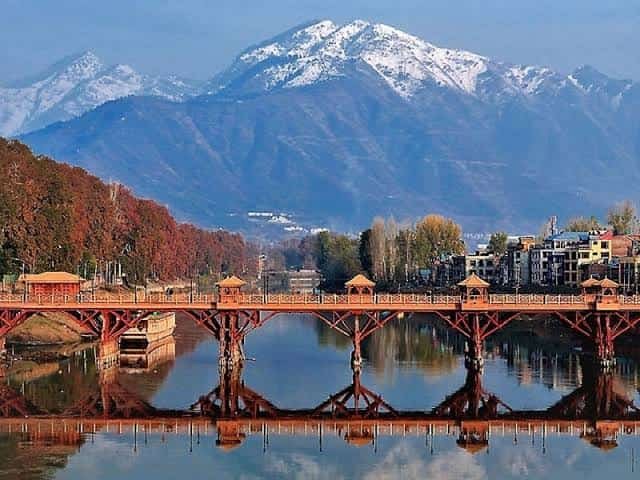
Zero Bridge is one of Srinagar’s best-known heritage bridges and a distinctive pedestrian landmark over the Jhelum River. Located between Rajbagh and the Sonwar side of central Srinagar, the wooden bridge is no longer used by cars or buses. Instead, it functions as a quiet pedestrian crossing, viewing point and part of the city’s developing Jhelum riverfront experience.
The bridge was originally built in the 1950s during the tenure of Bakshi Ghulam Mohammad. It later became unsafe for regular vehicle movement and was closed to vehicular traffic around the late 1980s or early 1990s. Major sections were dismantled in 2012, after which the Jammu and Kashmir Projects Construction Corporation rebuilt and refurbished the bridge in a traditional wooden style. The restored bridge reopened for pedestrian use in 2016.
Today, Zero Bridge is important less as a transport bridge for vehicles and more as a heritage public space. The nearby Abdullah Bridge carries road traffic across the Jhelum, while Zero Bridge gives residents and visitors a walkable connection between the two banks. Its role has also grown with Srinagar’s Jhelum Riverfront project, which has added promenades, cycling space, lighting and public areas around the river.
Quick Overview of Zero Bridge
| Particular | Details |
| Name | Zero Bridge |
| Location | Srinagar, Jammu and Kashmir |
| River | Jhelum River |
| Connects | Rajbagh and Sonwar-side areas |
| Bridge Type | Wooden arch / heritage pedestrian bridge |
| Approximate Length | About 154-160 metres in published sources |
| Original Construction | 1950s |
| Vehicular Traffic | Not permitted |
| Current Use | Pedestrians, sightseeing and riverfront access |
| Major Restoration | 2012-2016 |
| Restoration Agency | Jammu and Kashmir Projects Construction Corporation (JKPCC) |
| Reported Restoration Cost | About Rs 11 crore |
| Nearby Vehicular Crossing | Abdullah Bridge |
| Nearby Areas | Rajbagh, Sonwar, Lal Chowk, Residency Road and Jawahar Nagar |
| Known For | Traditional wooden appearance, Jhelum views and heritage value |
Where is Zero Bridge Located?
Zero Bridge is located across the Jhelum River in central Srinagar. It is commonly described as connecting Rajbagh on one side with the Sonwar-side area on the opposite bank. The bridge lies close to some of Srinagar’s best-known central roads and commercial districts, including Residency Road, M.A. Road and Lal Chowk.
The setting makes it easy to include in a city sightseeing itinerary. Unlike a remote river bridge, Zero Bridge stands within the developed urban core, surrounded by hotels, offices, residential areas and riverside public spaces.
The modern Abdullah Bridge lies nearby and carries the vehicular movement that once used Zero Bridge. This separation is important for visitors: vehicles approach the area through the normal city road network, but the heritage bridge itself is experienced on foot.
Zero Bridge Route and Road Connectivity
Because Zero Bridge is pedestrian-only, its road connectivity is best understood through the streets and bridges around it rather than as a driving route across the Jhelum.
- Rajbagh: Major residential and commercial locality directly associated with the bridge.
- Sonwar: Important Srinagar locality on the opposite side of the Jhelum.
- Abdullah Bridge: Nearby concrete road bridge that handles motor vehicles across the river.
- Lal Chowk: Srinagar’s main commercial centre, located within the wider central-city road network.
- Residency Road and Polo View: Major shopping and visitor areas accessible from the city-centre side.
- A. Road: Important central Srinagar road providing onward connectivity.
- Dalgate and Boulevard Road: Useful connections for travellers heading towards Dal Lake and its hotel areas.
- Jawahar Nagar: Established locality adjoining the wider Rajbagh side of the city.
Why is Zero Bridge Important?
Zero Bridge is important because it preserves a layer of Srinagar’s 20th-century transport history while continuing to serve as a usable public space. It once functioned as a road crossing, but the construction of newer bridges and concern over the ageing wooden structure gradually shifted its role away from vehicular traffic.
Its preservation prevented the site from becoming simply another obsolete bridge. Instead, the restored structure now contributes to Srinagar’s pedestrian environment and tourism identity. Residents use it for walking and crossing the river, while visitors use it for photographs, river views and access to the Jhelum waterfront.
The bridge is also useful as a visual link between old-style timber architecture and the modern riverfront improvements being introduced in Srinagar.
Traffic Conditions Near Zero Bridge
There is no motor-vehicle traffic on Zero Bridge itself. The main traffic pressure is found on the roads approaching Rajbagh, Sonwar and the nearby Abdullah Bridge. This means a visitor can walk across Zero Bridge without sharing the deck with cars, buses or motorcycles.
Road congestion in the surrounding area can still become noticeable during office hours, shopping periods and busy tourist seasons. Abdullah Bridge carries much of the cross-river vehicular traffic nearby, so queues on its approaches can affect travel time to Zero Bridge even though the heritage bridge remains pedestrian-only.
For visitors arriving by car or cab, it is more practical to get dropped at an accessible point nearby and walk the final stretch rather than expecting vehicle access onto the bridge.
History of Zero Bridge
Zero Bridge was constructed in the 1950s during the period when Bakshi Ghulam Mohammad headed the Jammu and Kashmir government. It was initially used by both pedestrians and vehicles and became an important connection between the neighbourhoods on either side of the Jhelum.
As the wooden structure aged and traffic demands increased, regular vehicular use became unsuitable. By around the late 1980s or early 1990s, the bridge had been closed to motor vehicles. The nearby Abdullah Bridge subsequently became the practical road crossing for this part of Srinagar.
By 2012, deteriorated wooden components had reached the point where major dismantling and reconstruction were required. The decision was made to preserve the bridge’s traditional appearance rather than replace it with a conventional concrete road bridge.
Restoration and Present Wooden Design
The Jammu and Kashmir Projects Construction Corporation undertook the major restoration. Local reporting places the restored bridge at roughly 154 metres long, while some general references round its length to about 160 metres. The project cost was reported at around Rs 11 crore.
The reconstruction used timber and traditional architectural details to retain the heritage character of the bridge. Wooden decking, railings, covered sitting structures and decorative lighting helped transform it into a pedestrian-oriented public space rather than merely a repaired transport structure.
The refurbished Zero Bridge was inaugurated for exclusive pedestrian use in May 2016. The decision to keep vehicles off the restored deck also protects the timber structure from loads that would be inappropriate for its heritage role.
Why is it Called Zero Bridge?
The origin of the name is not completely settled, and two explanations are commonly repeated in Srinagar histories and local reporting.
One explanation is geographic: because the bridge lies upstream of older numbered or sequential crossings, it came to be regarded informally as the bridge before the ‘first’ bridge, and therefore ‘zero’.
Another popular local account says that the bridge was associated with a deaf contractor and that the Kashmiri word ‘Zorr’ or a similar pronunciation gradually became ‘Zero’. This story was reported when the old bridge was dismantled in 2012, but it should be treated as local oral history rather than a conclusively documented naming record.
Zero Bridge and the Jhelum Riverfront
Zero Bridge now benefits from Srinagar’s wider Jhelum Riverfront redevelopment. In 2023, the right-bank riverfront stretch from Zero Bridge towards the General Post Office area was inaugurated after being upgraded with pedestrian and cycling facilities, parks, public plazas, seating, lighting and other amenities.
The project gives Zero Bridge a stronger role as part of a continuous urban walking environment. Visitors can combine a short bridge crossing with a riverside walk rather than treating the structure as an isolated photo stop.
The Jammu and Kashmir Tourism Department’s current Kashmir Marathon route also highlights Zero Bridge among Srinagar’s recognisable riverfront landmarks, showing its continued place in the city’s public and tourism landscape.
Walking and Visitor Experience
Zero Bridge is best experienced on foot, especially when the Jhelum is calm and the wooden structure is reflected in the water. The bridge has covered wooden spaces and railings that give it a distinctive Kashmiri visual character.
Evening is particularly attractive because lighting along the bridge and riverfront adds to the atmosphere. Visitors should still remember that this is a functioning pedestrian crossing and public space, not a private viewing deck. Keeping the walkway clear and avoiding damage to the wooden elements helps preserve the structure.
There is no need to plan a long standalone visit. For most travellers, Zero Bridge fits naturally into a broader central Srinagar itinerary that includes Lal Chowk, Polo View, Residency Road or Dal Lake-side areas.
Public Transport Near Zero Bridge
Zero Bridge is in central Srinagar and is reachable by taxis, auto-rickshaws, e-rickshaws and local road transport. Visitors arriving from other parts of the city normally travel to the Rajbagh, Sonwar or nearby city-centre side and walk onto the bridge.
For longer-distance travellers, Srinagar Railway Station is outside the central city, while Srinagar International Airport is reached through the wider city road network. The bridge does not carry buses or railway tracks.
Public transport and cabs can take visitors close to the site, but the final bridge crossing is strictly pedestrian.
Major Landmarks and Places Near Zero Bridge
- Lal Chowk: Srinagar’s principal commercial centre and one of the most familiar city landmarks.
- Polo View Market: Popular pedestrian shopping area in central Srinagar.
- Residency Road: Important commercial road with hotels, shops and restaurants.
- Tourist Reception Centre area: Major visitor reference point in central Srinagar.
- Abdullah Bridge: Main nearby vehicular crossing over the Jhelum.
- Jhelum Riverfront: Redeveloped promenade and public-space network connected with the Zero Bridge area.
- Dal Lake and Boulevard Road: Major tourism zone accessible through central Srinagar roads.
Nearby Areas to Zero Bridge
- Rajbagh: One of the closest neighbourhoods and a major residential-commercial area along the Jhelum.
- Sonwar: Important central Srinagar locality on the opposite side of the river.
- Jawahar Nagar: Established residential and commercial area adjoining Rajbagh.
- Lal Chowk: Central business district within a short city-road journey.
- Dalgate: Gateway area towards Dal Lake and Boulevard Road.
- Wazir Bagh: Nearby locality within Srinagar’s central river corridor.
FAQs About Zero Bridge Srinagar
Q1. Can cars or motorcycles cross Zero Bridge?
No. Zero Bridge is a pedestrian-only heritage bridge. Motor vehicles use nearby road crossings such as Abdullah Bridge.
Q2. Is Zero Bridge the same as Abdullah Bridge?
No. They are separate bridges over the Jhelum. Zero Bridge is the restored wooden pedestrian bridge, while Abdullah Bridge is the nearby concrete bridge used by normal vehicular traffic.
Q3. Is there a toll or bridge-entry fee?
Zero Bridge does not function as a tolled road bridge. No regular bridge toll is associated with the pedestrian crossing; visitors should follow any locally displayed public-space rules or temporary access controls.
Q4. How long does a visit to Zero Bridge usually take?
The crossing itself is short, so many visitors spend around 20-40 minutes walking, taking photographs and enjoying the riverfront. More time is useful if the visit is combined with the Jhelum promenade or nearby central Srinagar markets.
Q5. Is Zero Bridge worth visiting in the evening?
Yes. The wooden bridge and riverside lighting make evening a popular time for walking and photography, while its central location makes it easy to combine with Lal Chowk, Polo View or Residency Road.