Ellis Bridge is one of Ahmedabad’s most important heritage structures and the city’s oldest surviving bridge across the Sabarmati River. The historic steel bowstring-arch bridge was completed in 1892 and helped connect the old walled city on the eastern bank with the newer residential and institutional districts developing on the western side. Over time, the bridge became so closely associated with the surrounding locality that Ellisbridge itself emerged as one of central Ahmedabad’s best-known neighbourhood names.
The original steel bridge was built by engineer Himmatlal Dhirajram Bhachech using steel imported from Birmingham. Ahmedabad Municipal Corporation’s heritage records state that it was completed for about Rs 4.07 lakh, below the original budget of Rs 5 lakh. As traffic increased, the narrow historic structure became unsuitable for heavy modern vehicles, so concrete carriageways were built on either side in 1999. The enlarged crossing was renamed Swami Vivekanand Bridge, while the old steel structure was retained as a heritage landmark.
The historic central span is currently undergoing major strengthening and restoration. As of August 2026, the work remains incomplete and the old steel bridge is closed even to pedestrians. The restoration is intended to convert the heritage structure into a pedestrian-only crossing after completion, while normal road traffic continues to use the newer concrete carriageways beside it.
Quick Overview of Ellis Bridge
| Particular | Details |
| Name | Ellis Bridge |
| Current Official Name of Expanded Crossing | Swami Vivekanand Bridge |
| Location | Central Ahmedabad, Gujarat |
| River | Sabarmati River |
| Historic Steel Bridge Completed | 1892 |
| Bridge Type | Bowstring-type steel truss bridge |
| Historic Bridge Length | About 433-480 metres, depending on measurement reference |
| Width of Historic Steel Bridge | About 6.25 metres |
| Number of Main Spans | 14 |
| Engineer | Himmatlal Dhirajram Bhachech |
| Concrete Side Bridges Added | 1999 |
| Current Historic-Span Status | Under restoration; closed to vehicles and pedestrians |
| Planned Future Use | Pedestrian heritage bridge |
| Nearby Areas | Ellisbridge, Paldi, Raikhad, Lal Darwaja and Ashram Road |
| Nearby Metro | Gandhigram Metro Station |
| Known For | Ahmedabad’s oldest bridge, heritage steel arches and Sabarmati crossing |
Where is Ellis Bridge Located?
Ellis Bridge crosses the Sabarmati River in central Ahmedabad. It links the old-city side around Raikhad and Lal Darwaja with the western side around Ellisbridge, Ashram Road and the Town Hall area.
This location made the bridge historically important because Ahmedabad’s walled city developed mainly on the eastern bank, while major residential, educational and civic growth later expanded west of the Sabarmati. AMC’s heritage department specifically credits Ellis Bridge with encouraging new development on the western side of the river.
The bridge is also closely integrated with the Sabarmati Riverfront. Important riverfront roads, promenades, gardens and public spaces lie near both approaches, making the crossing useful not only for through traffic but also for access to central Ahmedabad attractions.
Ellis Bridge Route and Road Connectivity
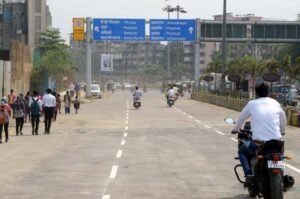
The bridge corridor provides an important east-west connection across central Ahmedabad. Motorists using the modern carriageways can move between the old city and major western-side roads without taking a longer route through another Sabarmati crossing.
A typical local movement is broadly: Lal Darwaja / Raikhad → Ellis Bridge crossing → Ellisbridge / Ashram Road → Paldi, Navrangpura and adjoining western Ahmedabad areas.
- Lal Darwaja: Major old-city transport and commercial hub on the eastern side.
- Raikhad: Historic locality adjoining the east-bank approach.
- Ashram Road: Important commercial arterial road on the western side of the Sabarmati.
- Paldi: Major residential and commercial locality south-west of the bridge.
- Navrangpura: Prominent commercial, educational and residential area accessible through western-side roads.
- Sabarmati Riverfront: Riverfront roads and promenades connected through the wider bridge approaches.
- Bhadra area: Historic city core accessible from the eastern side.
Why is Ellis Bridge Important?
Ellis Bridge is important for both transportation and city history. When it opened in the late 19th century, it created one of Ahmedabad’s earliest permanent cross-river connections and helped push development west of the Sabarmati.
Its role changed as the city grew. The narrow steel structure could no longer handle increasing motor traffic, which led to the construction of new concrete bridges on either side in 1999. This allowed the crossing to retain its strategic road function while preserving the original steel arches in the middle.
Today, the bridge is valuable in three ways: as a road corridor, as a protected heritage landmark and as a visual symbol of Ahmedabad’s transition from the historic walled city to a modern metropolis.
Traffic Conditions at Ellis Bridge
The historic 1892 steel bridge itself is not carrying normal traffic. It has been closed for years and is currently under restoration. Vehicles use the newer concrete carriageways constructed alongside the old structure.
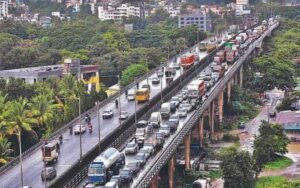
The wider Ellis Bridge corridor can still experience heavy traffic because it connects busy central-city roads on both sides of the Sabarmati. Congestion is influenced by movement around Lal Darwaja, Raikhad, Ashram Road, Paldi and the Victoria Garden junction.
A 2025 traffic study commissioned by AMC later identified Victoria Garden Junction in the Ellisbridge area among Ahmedabad’s priority congestion points for future grade-separation planning. This shows that traffic pressure around the bridge is often created by the approaches and junctions rather than by the river span alone.
History of Ellis Bridge
Ahmedabad’s first attempt at a bridge at this location dates to 1870-71. AMC heritage records state that the early wooden crossing built by British engineers was destroyed by floods.
A stronger steel bridge was then planned. The foundation stone was laid on 19 December 1889, and the new bridge was completed in 1892 by engineer Himmatlal Dhirajram Bhachech. Steel for the structure was imported from Birmingham, and the bridge was named after Sir Barrow Helbert Ellis, a prominent colonial civil servant.
The bridge was completed for about Rs 4.07 lakh against an estimated budget of Rs 5 lakh. AMC records note that Himmatlal was honoured after completing the work below budget. The bridge subsequently became one of Ahmedabad’s defining pieces of infrastructure and remained closely associated with the growth of the western city.
Architecture and Heritage Value
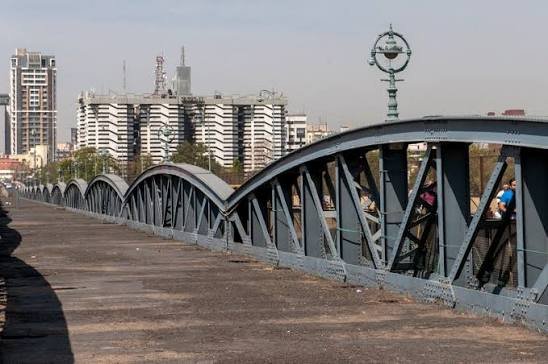
The original Ellis Bridge is a bowstring-type steel truss bridge with repeated curved steel arches. Its industrial-era appearance is very different from the concrete flyovers and box-girder bridges that dominate modern urban infrastructure.
Current restoration records describe the historic bridge as having 14 spans, each roughly 30.9 metres long, and an overall width of about 6.25 metres. Different historical and modern references give the total length at roughly 433 to 480 metres, depending on the measurement points used.
Ahmedabad Municipal Corporation declared Ellis Bridge and nearby heritage elements, including Manek Burj, protected sites in 1989. The bridge is therefore not simply an old road structure; it forms part of the protected heritage fabric of India’s first UNESCO World Heritage City.
Ellis Bridge Restoration and Current Status in 2026
The most important current development is the strengthening and restoration of the original steel bridge. AMC began the present major work in September 2024 after earlier structural and metallurgical studies identified deterioration in the ageing steel components.
The restoration scope includes repairing joints, replacing weakened bottom girders and stringers, reconstructing deteriorated deck portions and strengthening supporting elements. The project cost was initially about Rs 26.8 crore and was later revised to about Rs 42.9 crore.
The project has faced repeated delays. A July 2026 report said the extended deadline had already expired and the work was still incomplete. The old bridge remained closed even to pedestrians at that time. AMC’s stated intention is that, once restoration is finished, the heritage steel bridge will reopen as a pedestrian-only pathway rather than return to normal vehicle use.
Ellis Bridge and Swami Vivekanand Bridge: Are They the Same?
The names are closely related but can be confusing. The historic central steel structure is commonly called Ellis Bridge. In 1999, new concrete bridges were constructed on either side because the old bridge was not suitable for heavy traffic. AMC heritage records state that the revamped overall crossing was renamed Swami Vivekanand Bridge.
In everyday use, many people still say Ellis Bridge for the entire crossing and for the surrounding locality. For accurate bridge history, however, it is useful to distinguish the 1892 heritage steel bridge from the later concrete carriageways that carry present-day road traffic.
Public Transport Near Ellis Bridge
Ellis Bridge is located in a well-connected part of Ahmedabad. AMTS buses, auto-rickshaws and app-based cabs serve the surrounding areas, while the Metro provides an additional option for reaching the western side.
Gandhigram Metro Station on Ahmedabad Metro’s North-South corridor is one of the most practical stations for the Ellisbridge area. Gujarat Metro Rail Corporation’s current passenger information confirms Gandhigram as an operational station on this corridor. Paldi Metro Station is another useful option for destinations farther south.
For railway travel, Gandhigram railway station is also located in the wider Ellisbridge area, while Ahmedabad Junction is farther east in the old-city railway district.
Major Landmarks and Facilities Near Ellis Bridge
- Sabarmati Riverfront: Major public promenade and recreation corridor beside the river.
- Town Hall: Historic civic and cultural landmark near the western approach.
- J. Library: Important historic public library in the Ellisbridge area.
- Lokmanya Tilak Bag (Victoria Garden): Historic garden near the eastern approach zone.
- Bhadra Fort: Major heritage landmark in the old city.
- Gujarat Club: Historic institution near the bridge area.
- Manek Burj: Protected heritage structure associated with the old city and Ellis Bridge development.
- Gandhigram Metro Station: Operational Metro access on the North-South corridor.
Nearby Areas to Ellis Bridge
- Ellisbridge: The immediate western-side neighbourhood named after the historic crossing.
- Paldi: Established residential and commercial locality south-west of the bridge.
- Raikhad: Old-city neighbourhood on the eastern side of the Sabarmati.
- Lal Darwaja: Busy market and transport district close to the east-bank approach.
- Khanpur: Central riverfront locality north of the crossing.
- Navrangpura: Important western Ahmedabad business and residential district.
FAQs About Ellis Bridge Ahmedabad
Q1. Can visitors walk across the old Ellis Bridge right now?
No. As of August 2026, the historic steel span remains under restoration and is closed even to pedestrians. The plan is to reopen it as a pedestrian-only heritage crossing after the work is completed.
Q2. Do cars still use Ellis Bridge?
Vehicles use the newer concrete carriageways built on either side of the historic steel bridge. The original 1892 structure itself is not being used for normal vehicle traffic.
Q3. Is Ellis Bridge the same as Swami Vivekanand Bridge?
The names are closely connected. The original steel bridge is historically known as Ellis Bridge, while the expanded crossing with the 1999 concrete side bridges was renamed Swami Vivekanand Bridge.
Q4. Is Ellis Bridge the same as Atal Bridge?
No. Atal Bridge is a separate modern pedestrian bridge on the Sabarmati Riverfront, located between Ellis Bridge and Sardar Bridge.
Q5. Is there an entry fee for Ellis Bridge?
There is no road toll associated with the crossing. The historic steel span is currently closed for restoration, so normal visitor access to that section is not available at present.
Q6. Why do different sources give different lengths for Ellis Bridge?
Measurements differ depending on whether they refer only to the main historic steel structure or include approach portions. Recent restoration reporting gives about 433.4 metres, while some heritage and historical references use a figure close to 480 metres.
Q7. Will the restored Ellis Bridge reopen to cars?
AMC’s current restoration plan is for the old steel bridge to reopen as a pedestrian pathway, not as a normal vehicular bridge. Road traffic will continue to use the newer adjoining concrete carriageways.