Choosing a property is not simply about finding the right location or staying within budget. It is also about deciding how you want to live, how much responsibility you are willing to take on, and what you expect from your investment over time.
A flat offers the convenience of apartment living, a villa provides greater privacy and personal space, and an independent plot gives you the opportunity to build a home according to your preferences. Each option comes with different costs, benefits, and risks.
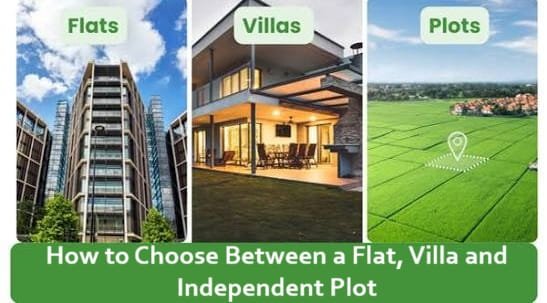
The right choice depends on your lifestyle, financial position, family requirements, and long-term plans. Before making a commitment, it helps to understand what each property type actually offers.
1. Start With Your Lifestyle, Not the Property Price
Imagine three buyers looking for a home in the same city. One wants a manageable apartment close to work, another needs a private garden for their family, and the third wants to build a customised house over the next few years.
Although all three may have similar budgets, their ideal properties will be different.
A flat generally suits people who value convenience, shared amenities, and access to established neighbourhoods. A villa is often attractive to families who want more privacy, outdoor space, and independent living. An independent plot may appeal to buyers who are willing to manage construction in exchange for greater design freedom.
Before comparing listings, identify your priorities. Consider your daily commute, household size, accessibility needs, preferred level of maintenance, and whether you want to move in immediately or can wait.
2. Buying a Flat: Convenience and Community Living
Best suited to buyers who prioritise convenience and predictable day-to-day living.
A flat, or apartment, is usually part of a larger residential building or housing complex. Depending on the development, residents may have access to lifts, security systems, parking, gardens, gyms, swimming pools, and community spaces.
One major advantage is that flats can be available in established urban locations where independent houses or large plots are expensive or difficult to find. This can make apartment living practical for professionals, smaller families, and first-time homebuyers.
Maintenance responsibilities are also shared. Common-area expenses are typically managed through a housing society or association, although residents must pay maintenance charges and follow community rules.
The trade-offs are worth considering. You may have less privacy, limited control over structural changes, and restrictions concerning renovations or common areas. Parking availability, noise, lift reliability, and the quality of society management can affect everyday comfort.
When evaluating a flat, examine the carpet area, monthly maintenance costs, building condition, parking arrangements, and the financial health of the housing association.
3. Buying a Villa: More Space and Greater Privacy
Best suited to families seeking private outdoor areas and a more independent lifestyle.
A villa typically offers a more private residential environment, often with multiple floors, a private entrance, and some form of outdoor space. Villas may be part of a gated community or located on individually owned land.
The biggest attraction is control over your immediate living environment. You may have more room for children, home offices, guests, gardens, or personal recreational areas. Depending on the development and applicable rules, there may also be greater flexibility for interior modifications.
However, that space comes at a cost. Villas generally require a larger initial investment than comparable flats in the same locality. Maintenance can also be more demanding because the owner may be responsible for the roof, exterior walls, garden, plumbing, and other private facilities.
In a gated villa community, monthly maintenance charges may still apply for shared roads, security, landscaping, and common amenities.
Before buying, check the ownership structure, land rights, construction approvals, drainage, water supply, security arrangements, and responsibility for maintaining shared infrastructure.
4. Buying an Independent Plot: Freedom With More Responsibility
Best suited to buyers who want to customise a home or develop property in stages.
An independent plot gives you land on which you may construct a house, subject to the applicable approvals, land-use rules, building regulations, and title conditions.
Its biggest advantage is flexibility. You can plan the number of rooms, architectural style, layout, parking, and outdoor areas around your needs and budget. Construction can also be scheduled according to your financial capacity, provided the project complies with local requirements.
However, purchasing land does not automatically mean you can build whatever you want. Zoning restrictions, setbacks, permitted building height, access roads, utility connections, and local development rules can limit what is possible.
Plots may also generate no rental income while you hold them vacant, unless there is a permitted income-producing use. If construction is delayed, you could face rising material costs, security concerns, or changes in the surrounding neighbourhood.
Before buying, verify the title, approved layout, land-use classification, road access, encumbrances, utility availability, and permissions required for construction. A lawyer and a qualified architect can help assess whether the plot suits your intended project.
5. Compare the Total Cost, Not Just the Purchase Price
The advertised price rarely tells the complete financial story.
| Cost factor | Flat | Villa | Independent plot |
| Initial purchase | Often lower than a comparable villa | Usually higher for similar locations | Depends heavily on land location and size |
| Regular maintenance | Society and common-area charges | Private upkeep plus possible community charges | Land upkeep and applicable local charges |
| Construction expenses | Usually included in the property price for a completed unit | Usually included, subject to specifications | Must be budgeted separately |
| Customisation | Often limited by building rules | Greater, subject to approvals | Generally greatest, subject to regulations |
| Time before occupancy | Often immediate if ready to move in | Often immediate if completed | Requires construction unless an existing house is present |
Also account for stamp duty, registration, legal fees, property taxes, loan costs, interior work, and emergency reserves.
If you are comparing a flat with a plot, estimate the full cost of building a house on the plot, including design, approvals, labour, materials, utility connections, and a contingency for unexpected expenses. Otherwise, the comparison may be misleading.
6. Think About Resale Value and Future Flexibility
A property’s future value depends on location, infrastructure, demand, quality, and purchase price—not simply whether it is a flat, villa, or plot.
Flats in well-connected areas may attract buyers who prioritise convenience and access to employment centres. Villas may appeal to households seeking privacy and larger living spaces, although the buyer pool can be narrower at higher price points. Plots may offer development flexibility, but their value depends on clear title, legal buildability, infrastructure, and demand for land in that location.
Consider how easily you could sell the property if your job, family size, or financial circumstances changed. Also assess whether the property can meet your needs for the next five to ten years without requiring another expensive move.
7. Make the Decision With a Practical Checklist
Before finalising your choice, ask yourself:
- Can I comfortably afford the purchase and ongoing expenses?
- Do I need to move in immediately, or can I wait for construction?
- How much privacy and personal space does my household need?
- Am I comfortable managing construction or major maintenance?
- Are the title, approvals, and ownership documents in order?
- Does the location fit my commuting, schooling, and daily travel needs?
- Would I still be able to manage the property if my income temporarily fell?
Answering these questions can narrow your options more effectively than browsing properties based on price alone.
Conclusion
A flat, villa, and independent plot serve different needs. Flats generally offer convenience and shared facilities, villas provide more private space, and plots give buyers greater control over future construction.
There is no universally superior option. The best choice is the property that fits your budget, lifestyle, and long-term objectives without creating unnecessary financial pressure. Compare the complete costs, investigate the legal documents, and evaluate the location carefully before committing.
Ultimately, the right property is not the one with the most features or the largest area. It is the one that works for your life today and remains practical for the years ahead.