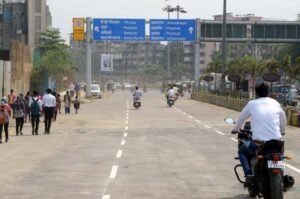
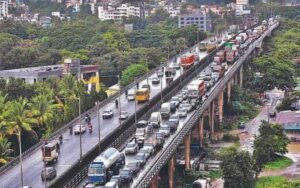
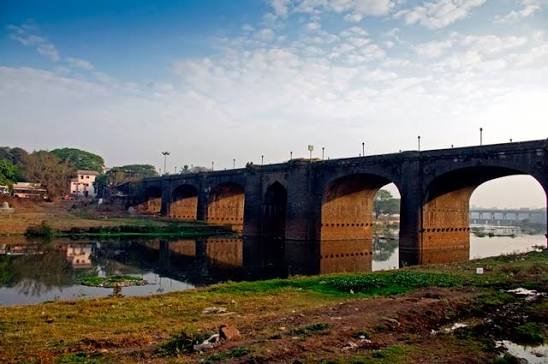
Shivaji Bridge, officially known as Chhatrapati Shivaji Maharaj Bridge, is one of Pune’s best-known heritage road bridges. Popularly called Nava Pul, the stone-arch bridge crosses the Mutha River and connects the Pune Municipal Corporation and Shivajinagar side with the historic core around Shaniwar Wada. More than a century after its completion, it continues to carry regular city traffic while also forming part of Pune’s architectural heritage.
The bridge was completed in 1923 after construction began in 1920. It was originally known as Lloyd Bridge, after Sir George Lloyd, then Governor of the Bombay Presidency, and was later renamed Chhatrapati Shivaji Maharaj Bridge. Because it was the newest major bridge in Pune when constructed, local residents began calling it Nava Pul, meaning “new bridge”—a name that remains widely used even after 100 years.
Shivaji Bridge is also substantial in size for an early 20th-century city bridge. Historical records give its length as about 201 metres, overall width as about 19 metres and carriageway width as about 11 metres, with pedestrian footpaths on both sides.
Quick Overview of Shivaji Bridge
| Particular | Details |
| Official Name | Chhatrapati Shivaji Maharaj Bridge |
| Popular Name | Shivaji Bridge / Nava Pul |
| Former Name | Lloyd Bridge |
| Location | Central Pune, Maharashtra |
| River | Mutha River |
| Completed | 1923 |
| Length | About 201 metres |
| Overall Width | About 19 metres |
| Carriageway | About 11 metres |
| Bridge Type | Historic stone masonry arch road bridge |
| Heritage Status | Grade-II heritage structure |
| Connects | PMC/Shivajinagar side with Shaniwar Wada and Old Pune |
| Nearby Metro | PMC Metro Station |
| Nearby Areas | Shivajinagar, Shaniwar Peth, Kasba Peth and Budhwar Peth |
| Known For | Stone arches, century-old heritage and central Pune connectivity |
Where is Shivaji Bridge Located?
Shivaji Bridge is located across the Mutha River in the heart of Pune. Its northern approach begins near the Pune Municipal Corporation headquarters and Shivajinagar side, while the southern end descends close to Shaniwar Wada.
This location places the bridge between two very different parts of Pune. To the north are the PMC headquarters, Shivajinagar and the modern Metro network. To the south are the closely packed historic neighbourhoods of Shaniwar Peth, Kasba Peth and Budhwar Peth.
The bridge therefore acts as a gateway from the Shivajinagar side into Pune’s traditional Peth areas.
Shivaji Bridge Route and Road Connectivity
Shivaji Bridge forms an important north-south connection through central Pune. A typical route through the area runs broadly as:
Shivajinagar/PMC → Shivaji Bridge → Shaniwar Wada → Shivaji Road → Budhwar Peth/Mandai → Swargate
- Shivajinagar: Major commercial, educational and transport district north of the river.
- Pune Municipal Corporation: Located immediately near the northern bridge approach.
- Shaniwar Wada: Pune’s famous historic fortification lies close to the southern end.
- Kasba Peth: One of Pune’s oldest neighbourhoods, accessible immediately beyond the bridge.
- Budhwar Peth: Major old-city commercial district along the Shivaji Road corridor.
- Mahatma Phule Mandai: Important market farther south through the old-city road system.
- Swargate: Major transport hub reached by continuing south through central Pune.
- Deccan: Accessible westward through adjoining Mutha River roads and central-city connections.
Why is Shivaji Bridge Important?
The bridge was constructed at a time when Pune was expanding beyond its older Peth neighbourhoods. It provided another major connection between Bhamburda—today’s Shivajinagar—and old Pune, improving movement between developing northern areas and the historic city centre.
Its role remains important because many key destinations sit immediately around the crossing. Residents, office workers, shoppers and visitors use the route for access to PMC offices, Shaniwar Wada, Kasba Peth, Budhwar Peth, Mandai, Shivajinagar, Metro services and Old Pune markets.
At the same time, the structure has architectural importance. Its stone arches and decorative elements represent a type of bridge construction that is increasingly uncommon in modern Pune.
Traffic Conditions at Shivaji Bridge
Shivaji Bridge remains an active city-road crossing, and traffic conditions are closely connected with the surrounding old-city street network.
The bridge itself has an approximately 11-metre carriageway within an overall width of around 19 metres, but its approaches feed directly into relatively constrained central Pune roads. Congestion can therefore occur even when traffic is moving normally across the bridge deck.
- Office-hour movement around PMC and Shivajinagar
- Shaniwar Wada visitors
- Shopping traffic in Budhwar Peth and Mandai
- Ganeshotsav processions
- Shiv Jayanti celebrations
- Religious events in the Kasba Peth area
- Temporary road closures in Old Pune
History of Shivaji Bridge and the Nava Pul Name
Construction of the bridge began in January 1920 under Rao Bahadur Ganpatrao Mahadeo Kenjale, with the project developed during the tenure of Sir George Lloyd, Governor of the Bombay Presidency. The structure was initially called Lloyd Bridge.
It was completed in 1923. Since this was the newly constructed bridge at the time, residents naturally referred to it as Nava Pul, or “new bridge”. Ironically, that informal name survived for a century and is still commonly used today.
After Independence, the bridge was renamed Chhatrapati Shivaji Maharaj Bridge. Its centenary was celebrated in September 2023.
Architecture and Heritage Value
Shivaji Bridge is a classic stone masonry arch bridge, quite different from Pune’s modern concrete flyovers and girder bridges.
The repeated stone arches transfer the load into large masonry piers standing in the riverbed. Decorative stonework along the structure also shows that aesthetics were considered alongside engineering.
The bridge survived the devastating 1961 Panshet flood, when floodwaters damaged many parts of Pune. Its heritage significance has resulted in classification as a Grade-II heritage structure, meaning alterations and maintenance have to take its historic character into account.
Bridge Maintenance and Structural Monitoring
Age makes regular inspection particularly important for Shivaji Bridge. Pune Municipal Corporation has included old structures such as Shivaji Bridge among the city’s ageing bridge inventory requiring periodic structural inspection, repair and strengthening.
This does not mean the bridge is presently unsafe. Rather, its age and heritage status make masonry repair, drainage maintenance and periodic monitoring particularly important.
Shivaji Bridge and Pune’s Heritage Walk
Shivaji Bridge has also become part of Pune’s tourism and heritage circuit. PMC heritage walks have used the bridge area near the municipal headquarters as a starting point before continuing through landmarks such as Shaniwar Wada, Kasba Ganpati, Lal Mahal, Dagdusheth Halwai Ganpati Temple, Nana Wada, Tulshibaug and Vishrambaug Wada.
For someone exploring historic Pune on foot, the bridge marks a natural transition from the modern municipal and Shivajinagar side into the dense historic core south of the Mutha.
Public Transport Near Shivaji Bridge
The bridge has very good access to Pune’s public transport network. PMC Metro Station is the most convenient Metro facility in the immediate area. Other options include PMPML city buses, auto-rickshaws, app-based cabs and walking connections into the Peth areas.
Major Landmarks and Facilities Near Shivaji Bridge
- Shaniwar Wada: Historic Peshwa-era landmark close to the southern end.
- Pune Municipal Corporation headquarters: Major civic landmark on the opposite side.
- Lal Mahal: Historic site near Shaniwar Wada.
- Kasba Ganpati Temple: Pune’s gramdaivat and an important old-city temple.
- Dagdusheth Halwai Ganpati Temple: Major religious landmark within the nearby old city.
- Nana Wada: Historic structure in Budhwar Peth.
- Mahatma Phule Mandai: Major heritage market farther south.
- PMC Metro Station: Convenient rapid-transit access.
Nearby Areas to Shivaji Bridge
- Shivajinagar: Major commercial and transport district immediately north of the river.
- Shaniwar Peth: Historic central Pune neighbourhood beside the southern approach.
- Kasba Peth: One of the city’s oldest settled areas, located close to Shaniwar Wada.
- Budhwar Peth: Dense commercial and historic district farther south along the old-city corridor.
- Narayan Peth: Established central neighbourhood west of the bridge area.
- Deccan Gymkhana: Important commercial and educational district accessible west of the Mutha corridor.
FAQs About Shivaji Bridge Pune
Q1. Is Shivaji Bridge Pune the same as Nava Pul?
Yes. Nava Pul is the traditional local name for Chhatrapati Shivaji Maharaj Bridge. The name originated because it was Pune’s “new bridge” when completed in 1923.
Q2. Is there any toll for using Shivaji Bridge?
No. It is an ordinary urban road bridge within Pune and does not operate as a tolled crossing.
Q3. Can pedestrians cross Shivaji Bridge?
Yes. The bridge has pedestrian footpaths on both sides. Pedestrians should still use the designated walking space carefully because the bridge carries regular city traffic.
Q4. Is Pune’s Shivaji Bridge the same as the Shivaji Bridge in Kolhapur?
No. Kolhapur also has a Shivaji Bridge associated with the Panchaganga River, but it is a completely separate structure.
Q5. Is Shivaji Bridge a good starting point for exploring Old Pune?
Yes. The bridge area is a convenient starting point for exploring Shaniwar Wada, Lal Mahal, Kasba Ganpati, Dagdusheth Ganpati, Mandai and several other heritage sites.