Unexpected expenses can create financial pressure, whether you need to pay a medical bill, cover household costs, or manage a temporary shortage of funds. Banks offer different borrowing options to help customers meet these needs, including overdraft facilities and standard personal loans. Although both provide access to borrowed money, their structures, costs, repayment requirements, and uses are different.
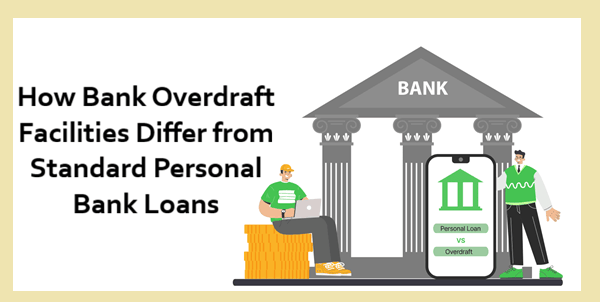
An overdraft facility allows eligible customers to withdraw more money than their available account balance, up to an approved limit. A personal loan, by contrast, provides a fixed amount that the borrower repays over an agreed period. Understanding these differences can help you select the right option for your financial situation.
What Is a Bank Overdraft Facility?
A bank overdraft facility is a credit arrangement that allows a customer to withdraw funds beyond the available balance in an eligible bank account, subject to an approved limit. It can help manage temporary cash-flow shortages without requiring a separate loan disbursement every time money is needed.
For example, suppose your bank account contains ₹10,000, but you need to make a payment of ₹25,000. If your bank has approved an overdraft limit of ₹20,000 and the transaction meets the account’s conditions, you may be able to use the facility to cover the shortfall.
Interest is generally charged on the amount actually used and for the period it remains outstanding. However, some overdrafts may involve processing fees, renewal charges, or other applicable costs.
Overdraft facilities can be linked to different types of accounts and may require collateral, a fixed deposit, or other security, depending on the product. Approval is not automatic simply because someone holds a bank account.
What Is a Standard Personal Bank Loan?
A standard personal bank loan is a fixed amount of money provided by a bank to an eligible borrower. Personal loans are commonly unsecured, meaning they do not generally require the borrower to pledge property or other assets as collateral.
Banks assess factors such as income, employment stability, credit history, existing debt obligations, and repayment capacity before approving an application.
Once approved, the loan amount is usually credited to the borrower’s bank account. The borrower then repays the principal and interest through scheduled monthly instalments, commonly called equated monthly instalments (EMIs).
Personal loans may be used for eligible expenses such as medical treatment, home repairs, weddings, education-related costs, or debt consolidation, subject to the bank’s terms.
Bank Overdraft Vs Personal Loan: Key Differences
| Comparison factor | Bank overdraft | Personal bank loan |
| Access to funds | Withdraw as needed within the approved limit | Usually received as a lump sum |
| Borrowing structure | Flexible credit facility | Fixed loan amount |
| Interest calculation | Generally based on the amount used and duration | Based on the outstanding loan under agreed terms |
| Repayment | May allow flexible deposits and withdrawals | Usually follows a scheduled EMI plan |
| Credit availability | Can be reused within the approved limit, subject to terms | Usually requires a new application for additional funds |
| Loan tenure | May be short-term or renewable | Usually has a defined repayment tenure |
| Eligibility | Depends on account, income, security, and bank policy | Depends on creditworthiness and repayment capacity |
| Common purpose | Short-term cash-flow shortages | Planned or larger personal expenses |
The exact features depend on the bank, account type, and individual credit agreement.
1. Access to Funds and Borrowing Flexibility
One of the main differences is how borrowers access money. An overdraft provides ongoing access to credit within an approved limit. Customers can withdraw funds when necessary, repay some or all of the outstanding amount, and potentially use the available limit again.
This flexibility can be useful when expenses and income do not arrive at the same time. For example, a person waiting for a delayed payment may use an overdraft to cover an urgent bill and repay it when the expected money arrives.
A personal loan is more suitable when the borrower knows the amount required in advance. The bank disburses the approved sum, and the borrower follows the agreed repayment schedule.
An overdraft is therefore generally more adaptable for fluctuating, short-term needs, while a personal loan may be easier to manage for a clearly defined expense.
2. Interest Rates and Other Charges
Overdraft interest is generally calculated on the amount used rather than the entire approved limit. If a bank approves an overdraft of ₹1 lakh but the customer uses only ₹20,000, interest is usually calculated on the outstanding amount of ₹20,000 for the relevant period.
However, overdraft facilities may have variable interest rates, renewal fees, or other charges. Customers should also check whether the facility has a minimum interest charge or conditions attached to maintaining the account.
Personal loans usually have a stated interest rate and repayment schedule. Fixed-rate loans can make monthly budgeting easier because the EMI generally remains unchanged throughout the agreed period, subject to the loan terms.
Neither option is automatically cheaper. Compare the effective borrowing cost, processing fees, applicable taxes, and other charges before deciding.
3. Repayment Terms and Financial Planning
Overdraft facilities may offer greater flexibility in repayment because deposits into the linked account can reduce the outstanding balance. Nevertheless, borrowers must comply with the bank’s minimum repayment requirements, limits, and repayment deadlines. An overdraft may also need to be renewed or cleared under the agreed conditions.
A personal loan generally follows a structured repayment plan. The borrower pays EMIs on specified dates until the loan is repaid. This arrangement makes it easier to estimate monthly obligations and the expected date of completion.
For example, someone who uses an overdraft repeatedly without reducing the principal may carry debt for an extended period. A personal loan with a defined tenure offers a clearer repayment endpoint, provided the borrower makes payments as agreed.
Before choosing either facility, calculate how repayments will affect essential expenses and existing financial commitments.
4. Eligibility and Security Requirements
Banks assess overdraft applications according to the type of facility. Some overdrafts are available against fixed deposits or other eligible collateral, while others may depend on income, account history, or a bank’s assessment of the customer.
Personal loans generally require an assessment of credit history, income, employment, and existing debt. Many are unsecured, but approval and loan limits depend on the applicant’s profile and the bank’s policies.
A secured overdraft may involve the risk of losing the pledged asset if the borrower defaults, subject to the contract and applicable law. An unsecured personal loan can still lead to collection action and other consequences if repayments are missed.
Review the eligibility conditions and default provisions carefully before accepting either form of credit.
Which Option Should You Choose?
A bank overdraft may be suitable when you need temporary access to funds, the amount required changes over time, and you expect to repay the balance soon. It can be particularly useful for managing short gaps between income and expenses.
A personal loan may be more appropriate when you need a specific amount for a planned expense and prefer predictable monthly repayments over a defined period.
Before applying, compare offers from reputable banks, read the loan agreement, and confirm all charges. If your financial shortfall occurs every month, consider reviewing your budget rather than relying repeatedly on borrowed money.
Conclusion
Bank overdraft facilities and standard personal loans both provide access to credit, but they serve different purposes. An overdraft offers flexible access to funds within an approved limit, while a personal loan provides a fixed sum with a structured repayment schedule.
The right choice depends on your borrowing needs, expected repayment timeline, total financing cost, and financial discipline. By comparing the actual terms and choosing a manageable repayment arrangement, you can use bank credit more effectively without placing unnecessary pressure on your finances.